
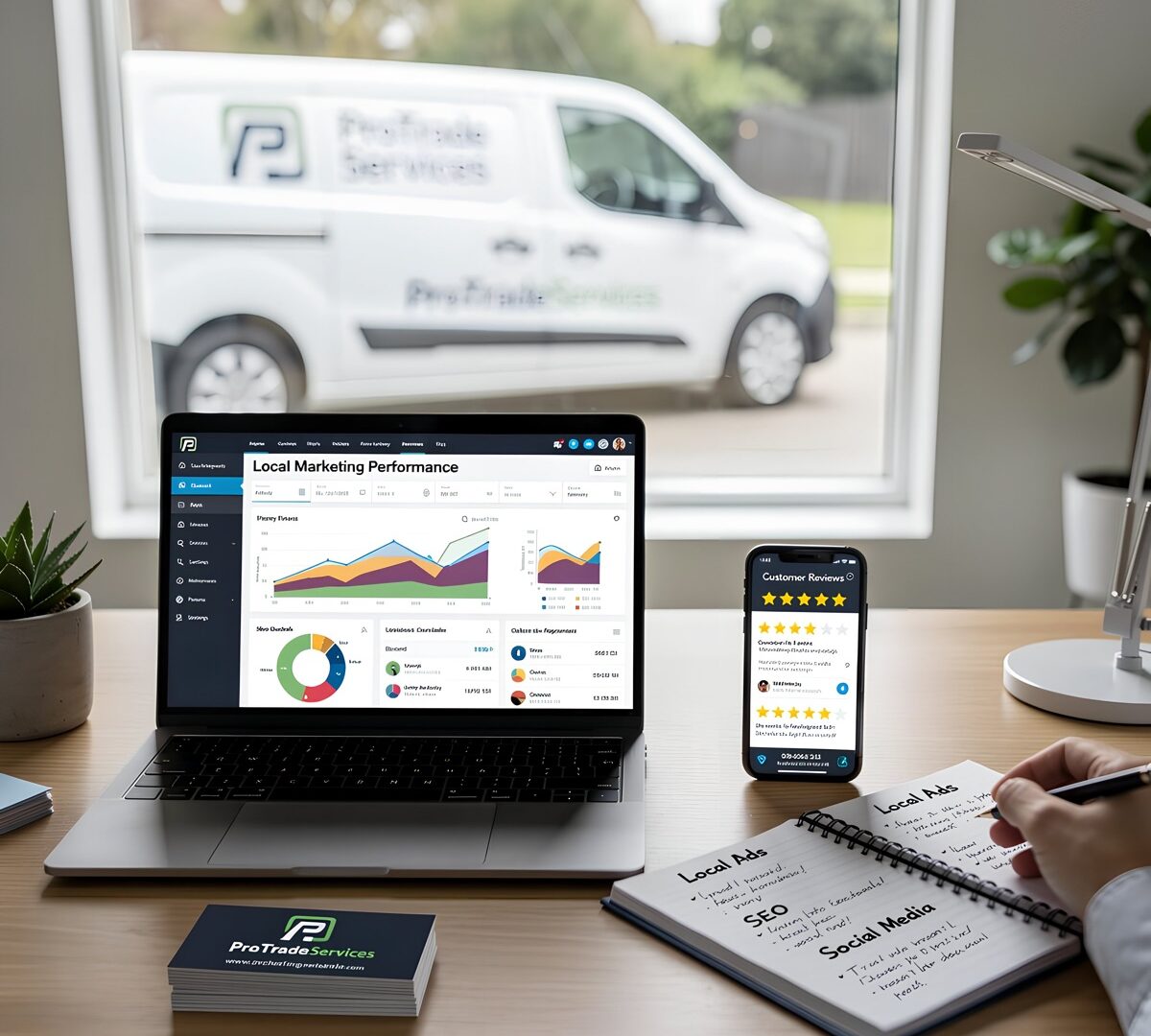
Many residential trade businesses assume marketing requires complicated strategies or expensive campaigns. In reality, most successful trade companies grow through a small number of consistent activities such as strong customer experience, word-of-mouth referrals, online reviews, and visible local presence. The businesses that focus on these fundamentals often generate steady work without needing complex marketing systems.
This means the marketing channels that tend to produce consistent work for residential trade businesses are fairly predictable: local search visibility, Google Ads for urgent work, online reviews, directories, social platforms like Facebook, and referrals from past customers.
Industry data supports this pattern. Around 76% of homeowners use search engines to find local home improvement services, and 93% of online experiences begin with a search engine.
But not every marketing channel makes sense at every stage of a trade business. The way a one-van operator should market is very different from a company running ten vans.
The real question is not which platform works. It is when each channel starts to make sense for the business.
Why Marketing Confuses Many Trade Business Owners
Most trade founders did not start their business because they enjoy marketing.
The early growth of a trade company usually happens through reputation. Good work leads to referrals. Customers recommend the business to neighbours. The phone rings because someone mentioned the company at a barbecue or in a local Facebook group.
For a while, that works.
But once a business hires staff and takes on fixed costs like vehicles, wages, and overhead, relying purely on word of mouth becomes risky. Work becomes inconsistent. Some weeks are full. Other weeks are quiet.
At that point, the founder often starts experimenting with marketing:
- Running Google Ads
- Posting on social media
- Paying for directories
- Hiring an agency
- Trying different platforms
The result is often frustration.
Some channels produce leads but poor-quality customers. Others generate traffic but no booked work. Marketing begins to feel unpredictable.
In reality, most marketing confusion happens because businesses try to run every channel at once instead of building a structured lead flow.
How Homeowners Actually Find Contractors
Residential services are now heavily influenced by online search behaviour.
Research into the home improvement sector shows:
- 76% of homeowners use search engines to find local contractors
- 97% of consumers search online for local services
- Around 50% of leads for home improvement projects come from online sources
- Businesses appearing in Google’s local results receive significantly more traffic and enquiries
Digital marketing now accounts for more than half of marketing budgets in the home improvement sector.
However, those statistics do not mean every trade business should immediately invest heavily in online advertising.
What matters more is which channels match the stage of the business.
What Marketing Works at Different Stages of a Trade Business?
A useful way to understand marketing for trade businesses is to view it through business maturity.
Different stages require different lead sources.
Early stage: When the business is small and founder-led
In the early stage, the goal is simple. Keep the schedule full without creating unnecessary marketing overhead.
At this stage, the marketing channels that usually work best are:
Referrals
Referrals remain the strongest lead source for most trade businesses. Satisfied customers recommend the company to friends, family, and neighbours. These leads convert at a much higher rate because trust already exists.
Many trade businesses grow to their first few staff members almost entirely through referral networks.
Encouraging referrals often comes down to small operational habits:
- Asking satisfied customers for recommendations
- Leaving behind business cards or magnets
- Following up after jobs
None of this feels like “marketing,” but it produces reliable work.
Local Visibility
Local visibility is another early-stage priority. This means showing up when someone searches for services in the area.
The most important asset here is a Google Business Profile. Businesses with well-maintained listings and photos often receive significantly more enquiries.
When someone searches for:
- plumber near me
- electrician in [suburb]
- emergency HVAC repair
The companies appearing in the local map results tend to receive the calls. For many early-stage trade businesses, simply appearing in local search results is enough to keep the calendar full.
Reviews
Online reviews have become one of the biggest trust signals for homeowners. More than half of consumers say reviews influence which contractor they choose.
A company with:
- 100+ positive reviews
- Consistent responses
- Visible customer feedback
Often wins work over competitors with little online presence. Reviews are not just reputation management. They are part of local search visibility as well.
Growth stage: When the business needs a consistent lead flow
Once a trade business hires several technicians and begins running multiple vehicles, the marketing conversation changes.
At this point, referrals alone rarely provide enough work to support the team. The company needs a predictable lead flow.
This is where structured marketing channels become important.
SEO: Long-term lead generation
Search engine optimisation (SEO) is one of the most powerful long-term marketing strategies for residential services.
SEO simply means making sure the company appears when homeowners search for services online.
For example:
- “Blocked drain repair”
- “Roof leak repair”
- “Air conditioning service near me”
Businesses that appear in organic search results receive consistent inbound enquiries.
Research shows 45% of contractors identify SEO as their primary lead generator.
SEO works particularly well for trade businesses because demand is highly local and often urgent.
If someone’s hot water system fails, they are not researching for weeks. They are calling the first credible company they find.
Paid search (Google Ads): Immediate lead generation
Google Ads can work well for trade businesses because they capture people who are already looking for help.
When someone searches for things like:
- Emergency electrician
- Blocked drain plumber
- HVAC repair near me
They are usually trying to solve a problem immediately. These searches often lead to jobs being booked quickly because the customer already knows what they need.
Google Ads works through an auction system where businesses bid to appear when people search for certain services. The more competitive the service and location, the higher the cost to appear near the top of the results.
In residential trades, this can vary quite a lot. Highly competitive services such as electrical and plumbing in major cities like Perth often see much higher cost per lead, because many businesses are competing for the same searches. In these situations, leads can easily cost $80 to $150 or more, depending on the job type and location.
More specialised or niche trade services often see lower costs because there is less competition for those searches.
For businesses running several technicians, paid search can still make sense if the average job value supports the cost of acquiring the lead.
Modern campaigns now use automated bidding and AI optimisation to manage ads across different Google platforms such as search, maps, and YouTube. While this can improve performance, it also means campaigns need careful monitoring to ensure the budget is producing real enquiries.
Without proper targeting, it is easy for advertising spend to increase quickly without delivering profitable work.
Facebook and social platforms
Social platforms like Facebook are rarely the primary lead source for trade businesses.
But they still play an important supporting role.
Homeowners often research companies socially before hiring them. Seeing photos of completed work, team members, and customer feedback builds trust.
Some businesses also generate leads through local Facebook groups where homeowners ask for contractor recommendations.
Paid Facebook advertising can work in certain situations, particularly for:
- Renovation services
- Seasonal promotions
- Larger projects
Industry research shows that around 65% of contractors report success using Facebook ads for local marketing. But compared with search marketing, social media tends to generate lower-intent leads.
Directories and job platforms
Directories and job marketplaces are another common lead source.
Platforms where homeowners post jobs or search for contractors include services similar to HiPages, ServiceSeeking or local trade directories.
These platforms can provide fast lead flow, especially for younger businesses that have not yet built strong search visibility.
Around 80% of home service professionals rely on directories for lead generation at some stage.
However, there are trade-offs. Leads from directories are often shared with multiple contractors, which increases price competition. They can be useful in the early growth stage, but most established businesses eventually rely more on their own brand and search visibility.
Local positioning: The overlooked factor
Many trade businesses focus heavily on advertising platforms but overlook positioning.
Local positioning is simply how well the company is recognised in its service area.
This includes things like:
- Branded vehicles
- Consistent signage
- Community presence
- Local sponsorships
- Repeat customers
Trade businesses with strong local recognition often generate significant inbound work without aggressive marketing.
When homeowners repeatedly see the same company vans in the area, the business becomes familiar to them. Familiar companies receive the first call.
Signs Your Marketing Structure Needs Improvement
Many growing trade companies experience the same marketing symptoms.
These often indicate the lead system needs improvement:
- Work arrives in unpredictable waves
- The team is overloaded one month and quiet the next
- Leads come from too many different platforms
- Marketing spending increases but results remain unclear
- The business depends heavily on one lead source
When marketing lacks structure, it becomes difficult to forecast work or plan team capacity.
What Marketing Structure Works Long Term?
Trade businesses that build reliable lead flow usually focus on a few consistent foundations.
They build strong local search visibility – Appearing in local search results and maps produces steady inbound enquiries.
They invest in reputation – Positive reviews and customer feedback increase trust and conversion rates.
They use paid ads strategically – Google Ads help control demand and fill gaps when needed.
They maintain referral networks – Past customers remain one of the most reliable sources of new work.
When these pieces work together, marketing stops feeling random. The business develops a predictable pipeline of enquiries instead.
The key takeaway
Most residential trade businesses do not need complicated marketing strategies.
Homeowners usually hire contractors the same way they always have. They search locally, check reviews, and ask people they trust.
The businesses that consistently win work are simply the ones that appear in those places.
Marketing for trade businesses is rarely about chasing every new platform.
It is about becoming the company that customers find first when they need the work done.
FAQ
Common questions about Hypotential, membership, and getting started.
For many residential trade businesses, the most effective marketing comes from strong customer experience, referrals, and online reviews. When customers trust the quality of the work, they often recommend the business to others, which creates consistent demand without relying on expensive advertising.
Most trade businesses do not need complex marketing strategies. Many successful companies focus on maintaining strong local visibility, encouraging customer reviews, and delivering consistent service that leads to referrals.
Online reviews play a major role in how potential customers choose a trade business. Positive reviews help build trust and improve visibility in local search results, making it easier for new customers to find the business.
Before investing heavily in marketing, businesses benefit from ensuring their service delivery is consistent. Reliable communication, professional workmanship, and strong customer experience often generate referrals and repeat work.
Hypotential is a platform designed to help residential trade business owners build stronger companies as they grow. It focuses on practical topics such as pricing, hiring, leadership, and operational structure based on real experience running trade businesses.
Hypotential is built for trade founders who want to build structured businesses as their teams grow. This includes owners hiring their first staff as well as those managing larger trade companies who want stronger systems and leadership inside their business.