
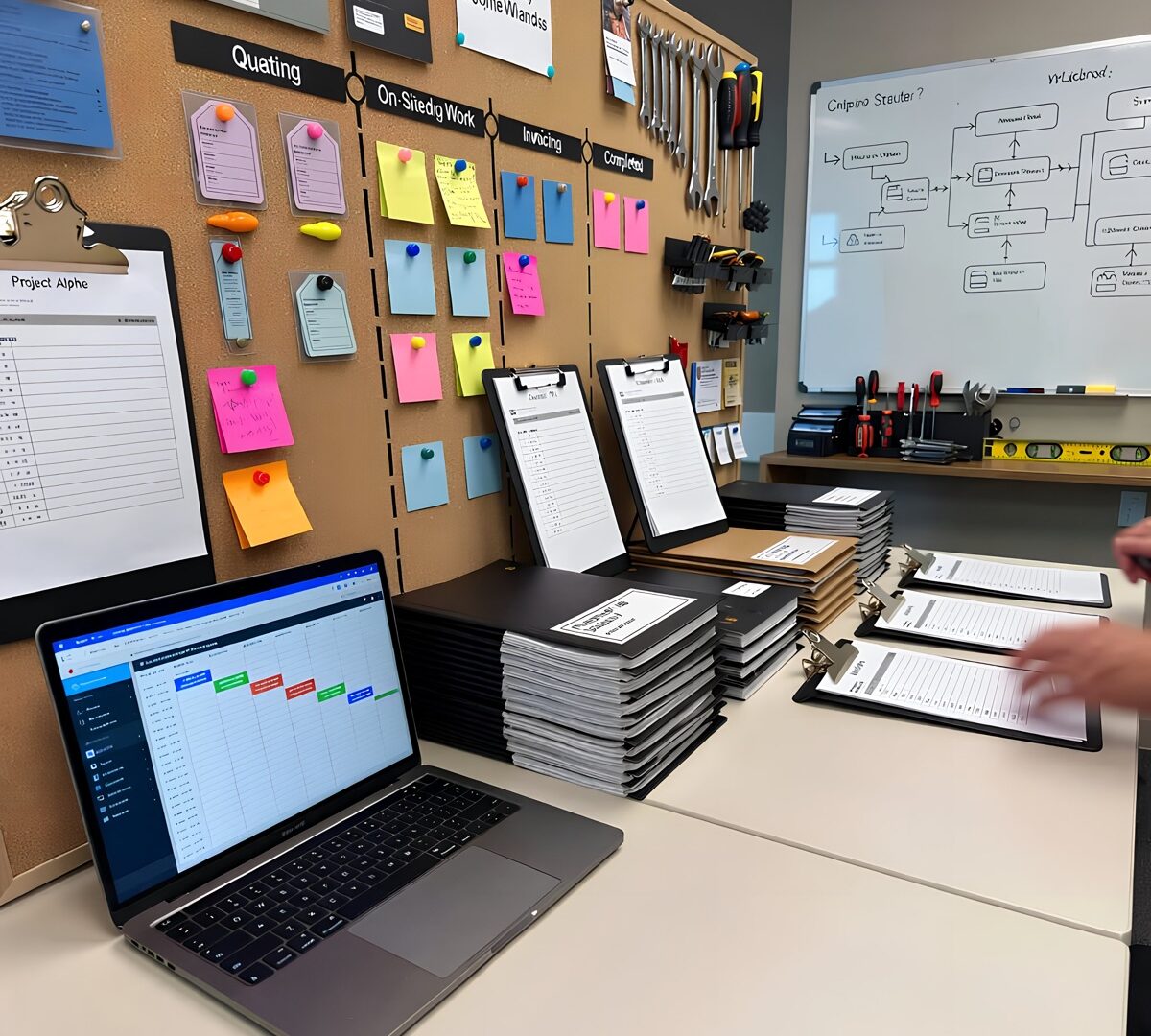
Residential trade businesses do not need dozens of complicated systems. Most successful companies rely on a small number of well-defined processes that guide how work moves through the business. These usually include how jobs are booked, how work is quoted, how jobs run on-site, how communication with customers is handled, and how finances are tracked.
Without these structures, growth creates pressure. Jobs get booked inconsistently, quoting depends on memory, and the owner becomes the person everyone relies on for decisions.
The businesses that stabilise as they grow usually do not start with complex automation. They first define repeatable processes for the core parts of the business. Once those processes are in place, tools and software can support them.
In most cases, a residential trade company only needs a handful of core systems to operate effectively.
The challenge is not technology. It is making sure the business runs the same way every time.
Why Systems Become Important as a Trade Business Grows
Most trade businesses begin with very few formal processes.
The owner answers the phone, quotes the work, completes the job, and sends the invoice. Because one person controls the entire workflow, everything runs consistently.
Problems begin once the business grows.
When technicians, apprentices, or office staff join the company, the way work happens becomes less predictable. Everyone may complete jobs slightly differently. Quoting decisions vary depending on who handles the request. Scheduling becomes reactive instead of intentional.
Without defined systems, the owner becomes the decision centre for everything.
Over time, this creates familiar problems:
- Constant questions from staff
- Inconsistent job outcomes
- Jobs are taking longer than expected
- Admin pressure increasing
- The owner is working longer hours despite hiring people
What started as a small business based on skill gradually becomes a company that depends on the owner’s memory and judgment.
Systems exist to remove that dependency.
Why Operational Structure Matters in Trades
Residential trade businesses operate on tighter margins than many owners expect.
Industry software platforms have reported that many trade businesses lose productivity through inconsistent job processes, poor scheduling visibility, and communication gaps between office and field staff.
These issues rarely appear when the business is small.
But once a company runs multiple crews, vehicles, and job sites each week, an operational structure becomes essential.
Systems create consistency. Consistency protects margin.
What systems a residential trade business actually needs
Most residential trade companies need systems in only five operational areas.
These are the parts of the business where work moves every day.
1. Job flow system
Every trade business should have a clear structure for how jobs move from enquiry to completion.
Typical stages include:
- Customer enquiry
- Job qualification
- Site visit or quoting
- Job approval
- Scheduling
- Work completion
- Invoicing
- Follow-up or warranty
Without a defined job flow, each team member may handle customers differently.
That leads to:
- Missed details during quoting
- Jobs booked without the right information
- Technicians arriving unprepared
- Delays in invoicing
A job flow system ensures every job passes through the same stages every time.
2. Quoting and pricing system
Many trade founders initially price work based on experience. That works when the owner completes most of the jobs personally. But once other technicians perform the work, pricing needs to account for labour time, materials, travel, and overhead.
A quoting system usually includes:
- Standard labour rates
- Material markup guidelines
- Minimum charge policies
- Time allowances for common tasks
- Clear approval thresholds
Without this structure, different people may quote similar jobs at very different prices. Consistent quoting protects margins and helps the team make pricing decisions without relying on the owner every time.
3. Scheduling and capacity system
Scheduling becomes one of the biggest operational challenges once a trade business has multiple technicians. Without a system, the schedule often fills with whichever jobs come in first.
Over time, this creates problems such as:
- High travel time between jobs
- Jobs running overtime
- Emergency work disrupting the schedule
- Technicians finish early, while others run late
A scheduling system defines how the business manages:
- Daily capacity
- Job duration estimates
- Priority work
- Emergency bookings
- Geographic job grouping
The goal is not perfect scheduling. The goal is the predictable use of labour hours across the week.
4. Job execution system
This system defines how technicians complete work upon arrival on site. Many trade businesses assume experienced technicians will automatically follow the same standards. In reality, small variations occur unless expectations are documented.
A job execution system usually covers:
- Job checklists for common work types
- Safety procedures
- Customer communication expectations
- Photo documentation requirements
- Job completion reporting
These processes do not need to be complicated. Even a short checklist can dramatically improve consistency across a team.
5. Invoicing and cash flow system
Cash flow pressure often appears when invoicing becomes inconsistent.
Common problems include:
- Technicians forgetting to submit job details
- Invoices are delayed until the end of the week
- Missing materials or labour time
- Payment terms unclear to customers
An invoicing system typically defines:
- When job information must be submitted
- Who reviews invoices before sending
- How quickly are invoices issued
- Accepted payment methods
- Follow-up process for unpaid invoices
In residential services, the speed of invoicing often directly impacts cash flow stability.
6. Reporting and visibility system
Once the business reaches several staff members, the owner can no longer rely on instinct to understand performance.
A basic reporting system allows the founder to track:
- Weekly revenue
- Labour utilisation
- Average job value
- Quote conversion rate
- Outstanding invoices
These numbers do not require complicated dashboards. They simply give the owner visibility into whether the business is performing the way it should.
7. Hiring and onboarding system
Hiring often becomes reactive in growing trade businesses. The phone is ringing, work is coming in, and the owner decides to bring someone on quickly.
Without a hiring system, new staff often start with little structure. They learn by observing others and asking questions throughout the day.
A hiring system usually includes:
- Role descriptions
- Interview questions
- Trial work process
- First-week onboarding structure
- Initial training expectations
This reduces the burden on the founder and helps new staff become productive faster.
Signs Your Business Is Missing Core Systems
Many trade founders recognise the need for systems only after problems begin appearing.
Common signs include:
- Staff are asking constant questions about jobs
- Quoting is taking longer each month
- Scheduling becoming chaotic
- Invoices are going out late
- Different technicians complete work differently
- The owner needs to approve everything
These patterns usually indicate the business has grown beyond what memory and verbal instructions can handle.
What Changes Fix the Problem
Trade businesses that move past this stage rarely do it by installing new software first. They start by defining how the business should operate.
That usually means:
- Documenting how jobs move through the company
- Standardising quoting guidelines
- Creating a predictable scheduling structure
- Defining how technicians complete work
- Establishing regular performance reporting
Once these systems exist, technology becomes useful.
Job management platforms, scheduling software, and automation tools can then support processes that already work.
But without the underlying structure, software simply adds another layer of complexity.
The key takeaway
Most residential trade businesses do not need dozens of systems. They need a consistent way work flows through the company.
Research into small business operations consistently shows that companies with documented processes and clear operational structure scale more reliably than businesses where knowledge remains in the owner’s head.
When quoting, scheduling, job execution, and invoicing follow clear processes, the business becomes easier to manage. Staff make better decisions, mistakes reduce, and the owner is pulled into fewer daily problems.
That structure is what allows a trade business to grow beyond the founder’s direct involvement.
The systems are not there to complicate the business. They exist so the business can run reliably, even when the owner is not standing next to every job.
FAQ
Common questions about Hypotential, membership, and getting started.
Most residential trade businesses rely on a handful of core systems that guide how work runs. These typically include job booking and scheduling, quoting and pricing, how jobs are completed onsite, customer communication, and financial tracking. These processes help the team work consistently and reduce the number of decisions flowing through the owner.
Systems help ensure work is completed consistently across the team. Without clear processes, jobs can run differently each time, which creates mistakes, delays, and extra questions for the owner. As a business grows, systems help maintain quality and reduce pressure on the founder.
No. Most successful trade businesses operate with a small number of clear processes that guide how work runs. The goal is not complexity but consistency. When the team understands how jobs should be booked, quoted, completed, and invoiced, the business becomes easier to manage.
Systems usually become important once a business begins hiring staff. When the founder is no longer completing every job personally, the team needs clear guidance on how work should run. Documenting processes early helps prevent confusion as the business grows.
Hypotential is a platform focused on helping residential trade business owners build stronger companies as they grow. It provides practical insights on pricing, leadership, hiring, and operational structure based on real experience running trade businesses.
Hypotential is designed for trade founders who want to move beyond running jobs themselves and build structured businesses with teams. This includes owners hiring their first staff as well as those managing larger trade companies looking for better systems and leadership.