About this episode
Smartfix started in 2018 with just me and my ute. Our second vehicle was a $1,000 Toyota TownAce from a car park in Fremantle, and within a week the engine caught fire on the Burns Beach on-ramp with my brother Finley behind the wheel, pouring a two litre jug of water over the engine bay because the fire extinguisher was empty.
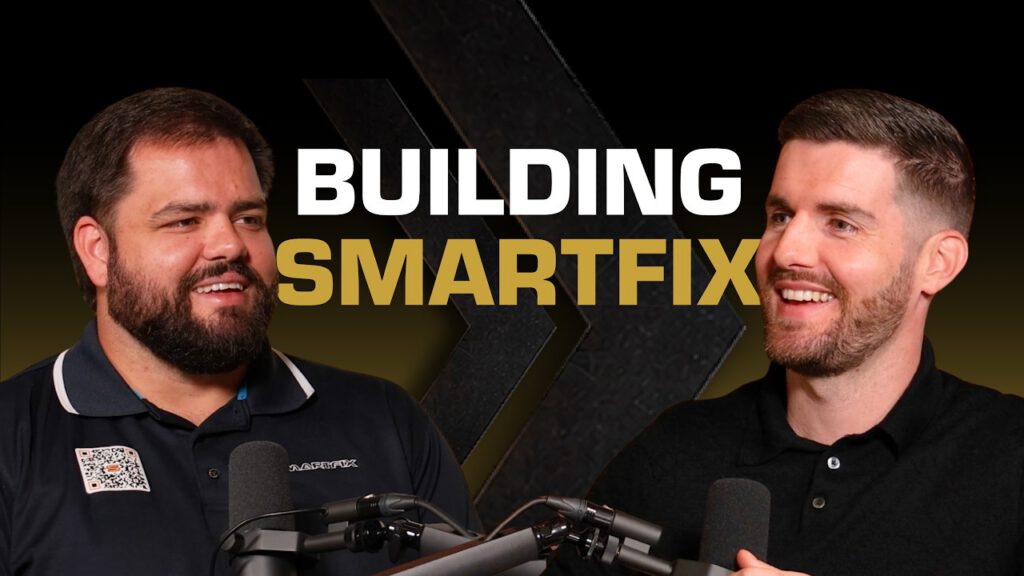
In Episode 9 of Unlocking Business, I sit down with Finley, my brother and the Head of Installations at Smartfix. He’s been with me for over eight years. We talk about the early days, working with family, the systems that made a difference, our hiring mistakes, and what it was like on the ground when the business nearly went under.
It’s a different kind of episode, and the most honest look inside Smartfix we’ve put out.
Who is Finley Dearlove?
Finley was about 20 and a fourth-year electrical apprentice at a new build company when I asked him if he wanted a job. I’d started Smartfix around six months earlier. He said yes without much hesitation, and I think we went and picked up the van the next day.
He came in thinking he’d finish his trade, get his licence and be a good sparky. Since then he’s worked as an apprentice, installer, salesperson and on the phones, through to running the field team. Today he manages sparkies, plumbers, ceiling fixers, painters and every other trade we have, with a small team in the office supporting him. He still has his day one shirt, with Smartfix and his name on it, in his wardrobe.
Key takeaways from the Smartfix story
1. Set boundaries early when you work with family
Finley made it clear from the start that he wanted to be my employee and for me to be his boss, not “he’s my brother” with the rules thrown out the window. We had the same goal but very different ways of getting there. I’m fast and reactive, he’s more sceptical and thinks through the what ifs, and we clashed over it. His partner Keely is now our office manager, so they have their own rule at home: debrief on the dog walk, and after 5pm there’s no more shop talk.
2. Small 1% changes add up
Our early work orders had what felt like hundreds of questions. Now they ask for the core information the office needs to explain a job to a customer. Recently we combined two fields that said the same thing and added compliance details to the job information. As Finley puts it, if you make someone else’s job easier, they’re going to want to do it more.
3. Build systems for roles, not for one person
Too many of our roles relied on one person. When they were sick, on leave or gone, the knowledge went with them, or got passed along like Chinese whispers until it looked nothing like what we’d planned. We’ve spent the last couple of years on standard operating procedures and are starting to record Loom videos so anyone can cover a role for two weeks.
4. Tell your team what’s happening, every week
When things went wrong, other business owners were asking our guys on the road if Smartfix had gone into liquidation. It hadn’t, but that’s what happens when people don’t hear it from you. Since then I post an update in the company chat every Monday. Finley says honesty is what kept people loyal, including coordinators who stepped back into an earlier role for a while and are now in a better position.
5. Don’t overcomplicate your software
We went from Facebook Messenger to Microsoft Teams, with channels for operations, leadership, management and the electrical installers. For jobs we use ServiceM8, and Finley would recommend it to anyone starting out. We complained about it for years, but mostly because we used it wrong, and we nearly spent over $50,000 changing systems for a few minor fixes. I made the same mistake with Hypotential, jumping into HubSpot before switching to HighLevel, which is simpler and cheaper.
6. Hire into a plan, not an idea
During our fast growth we over-invested in ideas instead of plans. Some of the sales roles we created sounded great but didn’t work. We’d put an ad on Seek without knowing exactly what we needed and hope the person would bring the process with them. Without training or SOPs in place, we were setting them up to fail. Working out the process first would have saved us a lot of money.
Burning vans, deleted spreadsheets and every trade holding a paintbrush
That first TownAce had rust around every window frame, and Finley kept attacking it with a wire brush and zinc spray. He looked up the rego recently and it’s apparently still registered. Our first office was a little room upstairs with Finley’s back against a window in 45 degree summers, while I sat at the other end next to the air con.
Finley also remembers coming to work to find his spreadsheets and old forms gone, and me in my office with a big grin saying I’d deleted them. Now we have an archive folder. On quiet days, with around 30 vans booked only a few hours ahead, we’ve found other work for the team. We think just about every trade we’ve had has painted something in our office at some point.
“Smartfix is too big of a beast to kill. We’ve been through COVID, economic crises and money lost, and we’re still here, still chipping away.”
Finley Dearlove, Head of Installations at Smartfix
We also talk about the peak, when Smartfix was doing $30 million a year, with four offices and no profit. Leads were costing double what they should, our guys had 12 quotes each in their names, so they rushed and conversion dropped. We sold two offices quickly to pay bills and came close to losing everything. Finley was overseas when it hit and found out through Teams messages. We’ve since brought it back to 30 staff and one office, and we make slower decisions based on data.
Where to find Smartfix
Smartfix is the Perth electrical and air conditioning business Finley and I have been building since 2018. Finley runs the installers on the road every day.
- Website: teamsmartfix.com.au
- Instagram: @teamsmartfix
- Facebook: Team Smartfix
- LinkedIn: Smartfix Electrical & Air Conditioning
More episodes you might like
- Marketing, Branding and What Actually Works for Trade Businesses | Aisha Derrick
- Building a Trade Business That Doesn’t Rely on the Owner | Peter Craft
- Starting an Electrical Business and Pricing Your Work Properly | Angelo Rossi
Want help building a business that grows without burning you out? Work with me.
In this episode
- 00:00Intro and Finley's role at Smartfix
- 01:03The early days and expectations
- 03:09Joining as a fourth-year apprentice
- 04:12The first van catches fire
- 06:19Working with family and boundaries
- 09:28From sparky to the office
- 10:31The first office upstairs
- 11:32Different minds in the leadership team
- 14:38Small 1% changes to systems
- 16:43SOPs and roles that rely on one person
- 17:44Communication and Microsoft Teams
- 20:52Did Finley think the business would fail?
- 26:07Honesty with staff during the restructure
- 29:15Working with your partner
- 32:23Systems: Teams and ServiceM8
- 37:38Hiring mistakes: ideas without a plan
- 40:46Proudest moment: saying yes
- 43:53Quiet days with 30 vans on the road
- 51:13The $30M peak and what went wrong
- 55:22The future of Smartfix
Full transcript
Read the full transcriptAuto-generated from the episode, lightly edited for clarity
[00:00] Cold open
Finley: So I popped the bonnet latch and got to have a look underneath, and then just, boom, engine's on fire. I was like, "Oh, no."
Finley: What on earth is going on back in Perth?
Finley: There's part of me going, "No, I don't want to do that."
[00:12] Introduction
Kane: Hey, I'm Kane Tyler Smith, the founder and CEO of Smartfix and Hypotential. This is Unlocking Business, where we have real conversations around business, leadership, mindset and personal growth. If you've been getting value from these conversations, please take a second to like, subscribe and follow our channels. It helps us reach more people, bring on more guests and share more stories. Now, let's get into this episode. Today, I'm joined by my brother Fin, who's been a part of the Smartfix journey for over eight years. How are you?
Finley: Good. Yeah, good. It's been a fun day so far.
[00:40] Finley's role at Smartfix
Kane: What do you actually do at Smartfix?
Finley: That's a good question. Over the years, the roles have changed quite a lot. But today, I am the Head of Installations. So I run all the field staff on the road. I've got a small team of girls in the office that work alongside myself and take off a lot of the administrative strain, but yeah, I deal with all the guys on the road. All the installers that are doing the hard yards.
[01:03] The early days and expectations
Kane: So I'm going to talk about the early days, because that's when all the good stories are from. What were the best parts of the early days, in your opinion?
Finley: I think the best parts of the early days were the ambition. Just the younger versions of us, thinking we can play video games all day and run a business, but that was obviously a short-lived reality. You have this mindset of what you think it's going to be. I thought it was just going to be yourself and myself, quote, install, do all that. I'd come from working at a new build company, and that was pretty much it. You get a job, go to a job. And then I took that mindset into working with you when you took me on board.
Finley: And I never thought it would be where it is today. I just assumed, yeah, we go do a job, finish the job, get payment, happy days. So yeah, it's just one of those things, not quite what I thought it would turn out to be.
Kane: That's the other question I was going to ask. Did you ever think it was going to be what it is today?
Finley: No. No, I didn't. No, 100%. That was the thing. Again, tying into that last one, it was just one of those things where you go, what was your goal at the end of the day? And what I had envisioned it to be, for me, it was just a job. I didn't know anything different. I'd just come fresh from, well, I was just about to finish my apprenticeship. So yeah, I was a sparky apprentice. Cool, I'm just going to finish my trade, get my licence. Obviously at some point I'd thought about having my own business, and then Smartfix just kept getting bigger and bigger and bigger, and here we are today.
Kane: So when you started with me, was it your fourth year, hey?
Finley: Yeah, I'm pretty sure it was the tail end of my apprenticeship for sure. So I would have been 19 or 20. Yeah, just turned 20, I think. About 20 years old, fourth-year apprentice, and then pretty quickly I was qualified.
[03:09] Joining as a fourth-year apprentice
Kane: From memory, it was about six months in when I started the business.
Finley: Yeah, something like that. I can't remember the exact dates and stuff. Obviously that's all eight years ago now.
Kane: That's a long time ago. I'm pretty sure it was about six months in from when I started, which would have been mid-2018.
Finley: Yeah, sounds about right. Even then, to think of the conversation we had. I remember I was going to the MBH and we were talking about the van, and you were like, "Oh, do you want a job?" And I was just like, "Oh, yeah, yeah." I didn't really hesitate much back then. I was just like, "Yeah, let's do it. Let's give it a crack, see what happens."
Kane: It's funny, actually, talking about the van. Oh, God. That thing. Tell us about your first van at Smartfix.
Finley: The first van at Smartfix. What a car that was. Obviously us being car guys at heart, really. So there was that bomb of a van that popped up on Marketplace or Gumtree or whatever it was back in the day, and it's this old TownAce. In my last job I had a TownAce as well, in very, very similar condition.
Kane: Pretty bad.
[04:12] The first van catches fire
Finley: But yeah, I just remember, I think we'd had it for two or three days. I can't even remember. It feels like less than a week we had it, and I remember getting on the on-ramp heading south at Burns Beach. The Burns Beach on-ramp, anyway. I'm going up the hill and it's not accelerating. So I downshifted and it's still not accelerating. I thought, "Oh no, this can't be good." Again, I'm like 19 or 20, I don't really know much about cars at the time. And then I see smoke coming out of the bonnet. I just thought maybe the car had overheated. So I popped the bonnet latch and went to have a look underneath, and then just, boom, engine's on fire. I was like, "Oh, no."
Finley: I didn't know what to do. Then I'm looking for a fire extinguisher in the car, and the gauge was empty, and I was like, "Oh no." So I'm there with a big two litre jug of water, pouring it over the engine bay.
Kane: Oh. That's what you get when you buy a van for $1,000 from a car park in Fremantle with tie-dye as the ceiling.
Finley: Oh, God. It was the rust around all the window frames. I think every...
Kane: And you sprayed it.
Finley: Yeah. Like once a week, when I'd see a bad spot pop up, I'd get my wire brush and take off some of the rust, and then we had some white zinc spray or something. I think we bought the wrong cans instead of the proper galvanised stuff. So I'm pretty sure I just about resprayed that whole van before we got rid of it. I should have kept it.
Kane: It'd be cool to have that van.
Finley: Cut it in half and hang it on a wall.
Kane: Yeah. Where it all began. It's probably scrapped somewhere.
Finley: It's funny you say that, because in one of your last podcasts it flashed up and I saw the rego. It's still registered, supposedly.
Kane: Really?
Finley: Yeah. I was absolutely gobsmacked. Just for a laugh, I put it into the rego check for WA or whatever it is, and I think it's still got like eight months of rego on it. I was like, there's no way that thing's still on the road. That thing was a bomb.
Kane: I have to find it.
Finley: Yeah, literally.
[06:19] Working with family and boundaries
Kane: What were some of the hardest parts at the start of Smartfix, in particular the actual business itself?
Finley: I think one of the things is understanding your goals. For me, I had this mindset of, I want to be the big dog. But I think early boundaries were good. Understanding that I'm an employee and you're my boss. I think in the early days, having that is probably what helped, to go, okay, cool, you are my boss.
Kane: So working with family, it's a big thing. Like, never work with family, da da da.
Finley: Oh, yeah. 100%, working with family has definitely had challenges over time. Again, I think one of the things is understanding your goal. We want to work towards the same thing, but obviously we have different minds, so although the goal was the same, our journey to get there was different. And there were times where I'd get frustrated at you, because I'd see something and I'd be set in my ways on how this idea or concept would work, and how you would approach it. I see you as a bit more fast and reactive, and I've always said in the past that I'm a bit more sceptical and think about the what ifs.
Finley: So at the end of the day, we had the same goal in mind, but we had different ways of getting there, and obviously we would clash over that. Or at least I clashed with you. But I think what came with that was a lot of growth, as now a man, kind of thing. Back then I was like a teenager when I came in, so it was hard to really grasp what it was you were trying to achieve, and my own wants and goals as well. And over the years it's come down to, yeah, Smartfix is now my career choice. A lot of people go, it's a job. It's more of a lifestyle. It's a lifestyle choice you make, and I wouldn't change anything, to be honest.
[07:40] Shared goals in the early days
Kane: It's worth you mentioning it. Goals. What did you think our goals were at that early stage?
Finley: There are a lot of ways to look at it. There was being the best trade, being the biggest business, all the big, big, big things, and we definitely got there at one point. Obviously you want to be the biggest and best business in the industry, especially in the state, and be recognised nationwide kind of thing. So there was part of me that wanted that. I wanted it to be the best business in the industry. And I think in the early days, you and I doing the jobs on the road, we both wanted the same finished product for a customer. Wanting the best possible job, the best possible outcome for the best possible price. We still carry those goals today, but obviously on a different scale, with all the staff that we've got that contribute towards that.
[09:10] From sparky to the office
Kane: And what do you think were some of the best learning experiences at the start?
Finley: There's a lot. There is a plethora of lessons learned over the years, coming from having the mindset when I first started here of just being a sparky. That was the goal. I was just going to be a sparky, and I was going to be a good one. And then as you grew and showed me some of the behind the scenes and how business actually works, that's when my mindset shifted to, oh, I can be a contributor to this business. How can I help, kind of thing.
Finley: And that's when my work ethic switched gears, from I want to be the best installer to I want to be in the office, I want to take that next jump. There were obviously steps before I got to where I am today. From customer service and sales and managing people, office staff, field staff, sales staff, the list is huge. So the lessons are pretty large. Again, from when it was yourself and I to where it is today, the list is pretty huge.
[10:31] The first office upstairs
Kane: So you mentioned there going into the office. From memory, that first office we got, on Caloundra. Was that in our second year?
Finley: Yeah, it was pretty quick.
Kane: I don't remember. Was it?
Finley: Yeah, I'm pretty sure. We'd gone from the TownAce to the utes, and then we had the few that were parked out at your old joint, and then we had three.
Kane: Three utes at the house.
Finley: Yeah, and then it would have been close to four to six staff when we got that first office.
Kane: We had the little office upstairs.
Finley: Yeah, I was going to say, it wasn't long before you were in the office with me upstairs.
Kane: Yeah, it was pretty quick. In front of the window.
Finley: Yeah, got all the sunlight.
Kane: Yeah.
Finley: The summers were savage. Like 45 degrees bouncing off the window and you've just got your back there. I remember going home with tan lines burned on my neck. And then you had the air con down the other end.
Kane: Yeah, so I was on the cool side.
Finley: In the corner with the air con on, and then you'd turn it off. I'm looking at you down the aisle like, you'd better turn that back on.
[11:32] Different minds in the leadership team
Kane: You had a good point before, about how we're different in different aspects, and this has come up before in conversations on the podcast. To me that's always been super important, because obviously me, you, Josh and Cassie, we're all so different. And we're the leadership team for the company.
Finley: Yep.
Kane: And like I've said before, for me that's important, because now, with what I've learned, you do need other people to actually go, "Hold on a sec, before you make that decision, let's go through this process."
Finley: 100%. That is one of the things that even I've learned, because it was just yourself and I for a while, running the show and stuff. And again, I had a certain way of how my brain would work versus how your brain would work. But growth comes, and as we've gotten a bit older, our patience has grown, through business and dealing with hundreds and thousands of people over the years. And having what we now call the core pillars of the business, those people, and understanding that a different perspective can also open up other opportunities. I think you'd probably agree, having the other girls and guys that help us now in the office, they've also got their own opinions and ideas about how they think things work, which also helps us grab on to certain things.
Kane: That's a good point, because it could even be a generational thing. Obviously we're not old, but we're getting older, so bringing new people up, they might have a better idea of how Instagram works.
Kane: A new Apple technology, and we're like, "Oh."
Finley: Yeah. I've never really used social media myself.
Kane: Yeah. And obviously we have a team now that can help us do that.
Finley: Oh, yeah, I couldn't agree more. There are different people with different experiences, there are different walks of life that now work at Smartfix. Even just when we have the work functions and you get stuck chatting to that one person, you learn something new. You go, "Oh man, you've got a trait that could be really useful. You could do X, Y and Z with this knowledge or that trait that you have that someone else might not have." And it happens almost daily, speaking to the next person and the next person. There are so many people here with different walks of life and different understandings of how things work, which is so good, having that environment of people where everyone's pretty keen to give something a crack here too.
[13:37] Networking and outside perspectives
Kane: Yeah. And that's why I bring you to things like where we were yesterday. Networking with wholesalers and other businesses just to learn things and share ideas, because as we've grown, we have noticed other people do actually like sharing and stuff.
Finley: Yeah.
Kane: That's obviously what we're trying to do with Hypotential, going out and meeting people. For example, we had an online workshop and Q&A the other day, and there were people quite early on in business telling us how they do certain things. And it brings me back to those days where we would do something similar, and I'm like, okay, maybe we actually need to rethink how we do this. So then I'll go and look into Smartfix and adjust things to suit, because I haven't thought about it for so long, because I'm doing different things now. So it's good to have these conversations.
Finley: Yeah. Seeing what's on the ground. An outside perspective.
[14:38] Small 1% changes to systems
Kane: Yeah. Or even, I've been going on the road doing those quote days. I love doing that, because I pick up things, and then I get to speak to the quoters and see what they do in those situations, and try to make it easier for other people. Like, let's actually implement this change. You put a thing in the chat the other day about the job information. Cool, can we add the compliance things in there? There's another thing in there I want to change. It's got type and then description. But when I was on my ride along, it's the same thing. Can we just combine them? There are those tiny little 1%ers. For me, that would be so much easier.
Finley: It makes a huge difference. Again, it's an efficiency thing. And for us, a big part of my job is, there have only been so many people that can do what I do and have the patience with people to go, right. We look back at early day ServiceM8 and how we used to use that, and it was just a mess. We didn't know any better. We just thought this is how it worked. And I look back on things that people suggest now on how to make things better, and I go, "No, we've been there, done that." We've been through 100 variations, and those 1% changes we've made now, it is game-changing.
Finley: Again, if you make someone else's job easier, they're going to want to do it more. Do you know what I mean? So with the guys on the road, the less they've got to interact with a certain thing, the better. Like putting in a work order. We had it crazy overcomplicated back in the day. Think of the hundreds of questions we had. It was like, "Yeah, sign and fill one out." To what we have now, where it's, "Okay, cool, this is the core information that's required," so the office staff who aren't tradespeople can understand what it is you're talking about, and then we can pass it on to a customer when they ask those questions.
Finley: But yeah, those 1% changes, like putting in the compliance specifications. Like, "Oh, what's that?" And then when it gets passed to the office, if it's not myself looking at it but somebody else in a different trade, they can go, "Okay, cool, I understand that." Fortunately, plumbing and electrical compliance obviously have similar aspects, I guess.
[16:43] SOPs and roles that rely on one person
Kane: Yeah, that comes down to systems, and that's what we've been working on for a lot of the last couple of years, standard operating procedures. We're about to start doing the Loom videos of, this is what we actually do. If someone goes away for two weeks, cool, pass that information to the next person and they can cover the role as best as possible.
Finley: Yeah, and that was the thing. I feel like we had a lot of roles that were reliant on a certain type of person. And that's been one of the things, over the last couple of years, few years, we've refined certain processes to work for people, not a specific person. Not saying that one person has invented themselves.
Kane: Yeah, 100%. That's the thing. When you get new staff come through and you have that one person that can only show them how to do that one thing, that's a crack in the system.
Finley: Do you know what I mean? Because what if that person's off sick or on leave or no longer at the company? Because it has happened, that we've created these systems and somebody else has had all the reins, and it's been like a game of Chinese whispers of how yourself or myself or the combined management wanted it to be done. And then when it actually gets played out, you go, that's not even close to how we originally envisioned it. That's the Chinese whispers. We show you how to do this, then you pass it to the next person, and then the breakdown begins from there.
[17:44] Communication and Microsoft Teams
Kane: So that sort of makes me think of bad communication.
Finley: Mhm.
Kane: This is something that we're always bringing up at every toolbox meeting.
Finley: Yeah.
Kane: Similar to what you just said. If someone does make a change, you've got to tell everyone, or it's got to be put in those chats. And that's where now, for us, it's great, because we use Microsoft Teams and we've got all the channels and chats set up for the operations, the leadership, the management, the electrical installers. So we have all these things in place so that if we do make a change... Obviously me, I'll make some changes and then I'm like, I probably should have told someone. But now I can put it in the chat, do a screenshot, "I have just done this," and everyone's aware.
Finley: Oh, there have been many, many times where I leave work one day and come back another day and something's completely changed, and I go, "What on earth is going on here?" Then I go knock on Kane's door and say, "Have you touched this?" And he goes, "Yeah, yeah, I deleted that." And you go, "Oh, you're kidding." I remember the forms. I had a...
Kane: What was it, a spreadsheet? Was it a spreadsheet?
Finley: Oh, yeah, the spreadsheets back in the day. Again, an overcomplicated system for something so simple. But that's how the core of a lot of it worked.
Kane: A value...
Finley: Yeah, understanding value, tracking where particular jobs were, and we had the team dynamics, like who can do what, on there. And then coming to work and I'm like, I swear this was in this folder or wherever it was, and I'm like, what on earth is going on? And you go into Kane's office and he's got this big cheesy Grinch grin going, "Yeah, I deleted that." And you go, "Oh, you're kidding me."
Finley: I think one of them was, I had a folder that had all the previous forms in there, and I was looking for it because I think we were going to bring back a form or something, and that file was long gone. But I look back on those days now and I go, thank God they were deleted. Do you know what I mean? It's helped us re-evaluate that system anyway.
[19:48] Old brochures and the day one shirt
Kane: I know. Now we have archive files for that reason, so I can just put it in there and it's there for the future, because I think those original ideas and things are great to look at.
Finley: Yeah. Again, looking back, like I looked...
Kane: On one of our desks there are the old brochures, with the checklists.
Finley: Oh yeah.
Kane: So I go and look at them and I'm like, that was actually a great idea, but there are obviously reasons why we stopped doing it. I wonder if we can re-implement that idea differently so it works better. So I do think having the original stuff is good. And we just spoke about photos, and we were devastated. Imagine if we had all the photos from the old days, our old uniform.
Finley: Yeah, we did have some, but we lost them. I've actually still got my day one shirt. It's in my wardrobe. I probably should frame it, but it's pretty faded and the logo's just about worn off. It was the old JB's shirts, the cotton material, and it just had Smartfix and then my name on it.
Kane: Yeah. I think it was the first bunch of shirts we got. You could wear them for about half a day and then you'd have to change, because it absolutely stank, because it's a 100% cotton shirt. There's nothing worse than going through a roof space in 45 degree heat in a cotton shirt.
[20:52] Did Finley think the business would fail?
Kane: Was there ever a moment where you thought the business might not work?
Finley: Yeah, 100% there was. I look back, and I think you've spoken about it, the things that happened last year, making crazy business decisions and losing tons of money. That was one of the more recent times, where it was, oh, I might come back from my holiday to not have a job. But I spoke to our peers about it, and they'd go, "Oh, what's going to happen?" And you go, "Nothing. Smartfix is too big of a beast to kill." We've been through literally everything. We've gone through COVID, economic crises, monster company and money lost, blah, blah, blah. The list goes on, and we're still here, still knocking, still chipping away.
Kane: What do you think the biggest problem was? When we, obviously, when I say peak, we were...
Finley: When we peaked.
Kane: Peaked in value and stuff, yeah, and then it obviously hit the fan. What did it feel like through that time for you? Boots on the ground in the office?
Finley: Boots on the ground in the office during those times, there's a lot of stress that I try not to expose anyone to. As a manager, being that top end person, the people on the road, the people in the office answering the phones, they've got a job and they want that job. And it's hard to look at them and put a big smile on and give them a big thumbs up when you go, man, the building behind me is literally on fire, kind of thing. So it's pretty hard and quite stressful. And being a bit younger when those things were happening, not quite understanding how to react was a challenge in itself. But yeah, we've had some challenging times, but I feel like every business, you wouldn't be a business if you didn't go through those things.
[22:58] What changed for the better after 2025
Kane: What do you think has changed for the better since early 2025?
Finley: We're a lot more understanding and forgiving, I think. I think that's the one thing. Back then it was, this is happening and nothing's stopping it. Now, even just after 12 months, and we could go back over the years and the changes we've had, but more to do with last year to this year, I feel like everyone has gone, whoa, that was pretty scary, to, okay, if we try this, this might work. And that's where I feel like a lot of ideas and concepts are more, I guess...
Kane: Available, shared.
Finley: Yeah, they're more shared. I feel like we're a bit more of a committee kind of thing now, whereas before it was, this is how it's going to go and this is what's going to happen. Now it's more, what do you guys think about this? And even amongst us, because obviously, as you say, you've not stepped away, but you're doing bigger and better things and whatnot, however you word that part. But you've kind of left the reins to the other people in the office now, the other managers and stuff, to keep the business flowing smoothly.
Finley: And we'll talk amongst each other and come up with an idea, and it'll go around before we come to you for a final sign off on a change. So instead of you doing all the thinking for us, we just need to bring it to you and go, "Do you like this idea?" So I think that's helped a lot. It's definitely helped with team building and the environment we work in. A lot more people are more like, oh yeah, my words mean something now.
Kane: Mhm. Then it goes back to the point you mentioned just before, having the younger staff that come through, like the coordinators now, for example. They started with us in that customer service, receptionist kind of role on the phones, and progressed with us as we grew.
Finley: Mhm.
Kane: Obviously they had their roles changed when we were at peak size.
Finley: Yep.
Kane: And then obviously we had to change it. So for them it was a bit of a step back, because they had to go back into a role for a short time. And now we're able to rebuild the business in a different way.
Finley: Yeah.
Kane: And now they're in an even better position than they were. So they stuck with us through the hard times.
Finley: Yep.
Kane: And now they're in a position where they have a very good career path opportunity.
[25:40] Honesty with staff during the restructure
Finley: Yeah, 100%. I think for those people in those positions, they might have gone, oh, that's a stab in the back kind of thing. But I think what's helped is being honest with them, and that's what's kept them loyal. Loyal is probably the right word. They've gone, "Oh, I spoke to Kane, the CEO, the big dog of the company, and he's told me what's happening and why." Or even myself, because people respect me. So they'll go, "Oh, Fin has said this." And being honest with those people, going, "Hey, look, there's some change happening. It might not be the best, but give it some time and things will improve." And they do. They always do. And I think a lot of mistakes people make is they just think, oh, it's just going to be bad forever now. They don't give it time.
Kane: They drown in their sorrow, kind of.
Finley: Yeah, pretty much. They go, "Oh, this is the worst thing ever." But there's always a bigger and better thing around the corner. You've just got to sit tight.
Kane: I think that again comes back to communication.
Finley: Yep.
Kane: And me having people around me, because I'm not the best person to, I suppose, console in a way. So that's where we've got Cassie and Keely, who are better at that, especially with their teams. So I think having open communication...
Finley: Yeah.
Kane: That was a thing I learned through that period, and I still do it now. Every Monday I put a post in the company chat with some updates from me. "Okay, this is what happened last week. These are some slight changes." But I learned that back then, when the culture got a bit how you going for a while, with what is going on. Once I learned that, it was, just tell people, "Hey, this is what's happened. We have just lost a lot of money. We are restructuring the company. Come and chat to us if you do have any concerns." Which again is hard, because people don't do that. But that's where they have their managers and their friends in the business that they can go to and ask those questions.
Kane: Or there'll be people on the road that I'm closer with, and they'll come to me. I'll tell them what's happening, then they can go and spread the information instead of rumours, because that was the thing I wanted to avoid, false rumours. You'd hear from other business owners, "Hey, has Smartfix gone into liquidation? They're closing?" Then I hear that from one of my guys on the road, and I'm like, "No." I need to start telling people everything. And I still do it to this day, and I think that's super important.
Finley: I couldn't agree more. Even for me, although, yes, being a brother, there's definitely information that I'd miss out on. So people would come to me and I'd have to clarify, or I personally don't know. Unfortunately, there were times where people would come in and go, "Am I going to lose my job?" And I go, "No, you're not going to lose your job," but I don't know.
Kane: But if you say it without confidence, mate, they might read that off you. Like, "Yeah, he doesn't know."
Finley: Yeah. So I think, they always say honesty is the best policy, and I feel like we've definitely come a long way from day one to eight years down the track. Not that we've beaten around the bush on certain things, but there was a lack of openness, I guess you could say. Where we were five years ago to today, it's a different business. We joke in the office, myself and Cassie and the others, we all say, "Oh, I think we're on version 73 of the business."
Finley: Working with family, again, has definitely had some challenges. But as we've both grown as men, I feel like you and I have both come a long way in our relationship. I think if we were in the original building in the same office, it'd be like an episode of The Simpsons every day, where you're strangling Bart kind of thing. So working in a different area, obviously I don't see you every day. There'd probably be times where I don't see you for a week. But I think a key thing is just understanding each other's goals and whatnot.
[29:15] Working with your partner
Kane: And just realising as well, working with family, it's not just me. So, your partner is the office manager.
Finley: Yeah. Yeah, so Keely, my partner, she's the office manager. But again, same thing, she works in a separate part of the building, and our roles don't really intertwine with one another, compared to myself and Josh, the sales manager. Obviously I deal with him all day, whereas with Keely, we don't really have much to do with each other's jobs during the day. So although we work together, I don't see her pretty much at all throughout the day, apart from warming up lunch or making a coffee kind of thing.
Kane: So even if you compare it to me, obviously with my wife, we don't really talk about work as much outside of work. So for you, it's actually a full-on thing. How do you separate business from personal life outside of work?
Finley: Yeah, we do joke about this a bit, because although we work together, I kind of know what's going on in her day, and she kind of knows what's going on in my day. So we go home and talk about the things that happened throughout the day, something that happened on a job, or something that happened in the office, in her office particularly. But we try and set a time in the day where we go, no more shop talk. Because if you get stuck talking work all day, every day, then it's like...
Kane: You'd go mad.
Finley: Yeah, you'd lose your mind.
Kane: So how do you do that then? Is it, you get home, do dinner, do all your things? Is it literally a certain time of day?
Finley: Yeah. It depends what's happened that day, but for the most part, from 5pm, that's it, no more. I'll see you.
Kane: Get home, debrief.
Finley: Yeah. Debrief. And fortunately, Keely's super chill, so there's not really anything negative to talk about. It's just the normal things. How was your day? What did you do? Who did you see? Who did you speak to? Any funny customers? We've got a dog now, so we kind of go, right, we'll take the dog for a walk, and that's where we debrief. And when we get home from the walk or the drive or whatever, we go, all right, that's it, no more. We'll just leave it in the car or leave it on the walk. So that's a boundary Keely and I both agreed on in the early days, going, yeah, working together, we can't let work get in the way of our relationship.
[32:23] Systems: Teams and ServiceM8
Kane: Mhm. What are some of the systems in business you think made the biggest changes to Smartfix?
Finley: Having a clean communication system with the guys. In the early days it was easier to make those phone calls. It was easy to make a phone call and have a chat with one of the guys when we were, what, a team of 10 kind of thing. It's way easier. Way more time in a day. But as we are today, with 35 people on the road or whatever it is today, it's obviously quite a few guys. So it does get challenging to communicate via phone call every day, because it's not just those guys on the road. It's the customers that want to call and speak to you, or a sales rep from another company, or whatever it may be. Before you know it, you blink and your day's gone. There just aren't enough hours in a day to have a chat with every single person.
Finley: But having a clean, clear area to communicate with people via message helps, because a lot of the guys that work for us are in a generation where they're happy to text. So it's easier for them to text or instant message or whatever it may be. Having an easy, functional way for them to communicate one-on-one, in a group chat, within a department and between departments definitely helps. So going back to the whole communication thing, communication in business is key, 100%. Having a clean area. We've gone from Facebook Messenger to Microsoft Teams. Obviously we floated some other ones back in the day, but that's a big one.
Finley: Obviously for me and what I do in a day, a job management system is a necessity. Whipping out your paper calendar or your paper diary is a thing of the past. It's too complicated. It's too confusing. It's too easy to miss something important or forget a customer because you forgot to write it down. So we use ServiceM8. There are obviously heaps of them out there, and there are ones that we would probably benefit from, but we're not too far deep, we've just got so accustomed and comfortable and made it work for us now. And it does work. I'd recommend it to just about anyone that's starting out. It's the perfect startup piece of software to use. We do complain about it a lot, but I think it's because we used it wrong for so long.
Kane: Yeah.
[34:30] Don't overcomplicate your software
Finley: And now we're like, actually, let's just use it how you're supposed to use it. And then obviously you've got the integration for the reporting software and things like that. And we were pretty close to spending a lot of money changing to a new system for a few minor changes, which would have probably cost us over 50k. And now you look at it and we've already got that for way cheaper, and we know how to use it. So why break something that is working?
Kane: Yeah. There are that many systems out there. I think people do drown in it. Oh my gosh, what do I use? What phone system? What CRM? What AI platform do I use? Just stick to one. Don't overcomplicate it.
Finley: And I think that's the thing. With AI available, people will deep dive too much instead of just giving it a go. You see it all the time now. Even I've become pretty reliant on it. But I can imagine people doing their own research on what type of software is going to work for their business. They're going to overcomplicate it and go for the biggest and best thing, and it's not what they actually need. They just need something simple to get by for now and learn, especially if they've never done it.
Kane: That's actually a good example. I did exactly the same thing I'd done before with Hypotential. I jumped deep into HubSpot, because it's got one of the best names, and it can do everything. But you sign into it and you need someone to do an implementation program for you, because it is that complex.
Finley: Yeah.
Kane: And HighLevel is what we use now. You look at that, and it's probably like a ServiceM8 compared to, I don't know, Simpro or something.
Finley: Yeah.
Kane: It's just significantly easier. It is cheaper. And I'm not ready to invest like 20k for someone to implement a system for a startup business.
Finley: Yeah, 100%. That's what I mean. Yes, we have issues with ServiceM8 at times, and again, it's probably more of a user issue than something actually wrong with the system. Admittedly, I've had a couple of accounts on ServiceM8 now, because my account would just stop working. Then you make a new account and it's working perfectly fine. So we've had those little teething issues. But again, it's overcomplicating something that just needs to be simple.
Finley: Sometimes you've just got to take a step back and go, "What is it I actually need?" And that's easier said than done, because if you don't have another person to bounce that idea off, especially at a new start company, they just go, "Cool, I'm just going to use AI. I'm going to figure out what they recommend. What's the best rated? What are other people saying online?" And then they recommend another big CRM or job management system, and people point you in the wrong direction. That's where ServiceM8's been a godsend, because I don't need all of the information that we probably do need. All I care about is understanding where my jobs are, who's on those jobs and how long those jobs are for. If it's too complicated for me to use, I'm probably just not going to use it. And it's probably my own stubbornness, how my brain works on certain things.
Kane: The one thing for ServiceM8, if you're listening: you need customer reps. You need customer reps. Don't just palm us off to a partner. You guys need reps, because your business could grow significantly if you just listened to advice from businesses.
Finley: Yeah.
Kane: Not everyone, obviously, but if you get all this information, just do this thing. For example, service departments, like electrical, plumbing, air con. If you could separate them in ServiceM8, you'd open up your client base significantly.
[37:38] Hiring mistakes: ideas without a plan
Kane: Tell me about some of the mistakes we made, in your opinion, at Smartfix through our fast growth period, more specifically on hiring and recruitment. What would you say some of our mistakes were?
Finley: I guess to generalise it, I think we would over-invest in an idea as opposed to investing in a plan. We had this big picture of, yeah, we're going to do this and then we're going to do that. But they were ideas. They were concepts. They weren't thought out and planned. And I look back on the past and go, that didn't work. That was a bad idea. Obviously my job is to run the guys on the road, but I see everything. Being your brother, you'll obviously come to me with some information, just having a few ideas. You love an idea.
Finley: But I think in the early days, even with staff, whatever it may be, we had an idea of what it was going to do, and the reality was it wasn't just that. Think of some of the positions we had in the office back in the day in the big building. We don't even consider that as an option for us anymore. I think some of the sales positions we had, it sounded so good as an idea, but as a planned out concept, it just didn't work. Unfortunately, I feel like that comes down to a certain type of person you'd want to do that job. When you put that ad up on Seek for that role, and we don't know exactly what it is and what they're needed for, we're not 100% sure what it is we're looking for, and we're just hoping somebody can fill those shoes. And that goes back to an earlier topic, creating a system that's based around a particular type of person. So that's one of the big things we've changed over the years.
Kane: I was going to say, that brings up a point. What you just said was a very good point, but there's also definitely us hiring people without the structures in place, and then winging it and leaving them, and going, why hasn't it worked? We hadn't provided the correct training or the standard operating procedure. Looking back now, it would have been so much easier, and would have saved a lot of money, if we'd thought out the process before we hired the person, as opposed to looking for someone and hoping they're going to bring in...
Finley: Yeah, the process.
Finley: Yeah. I think that was the thing. We had this idea, it was a great idea. We had some cracking ideas over the years, but it was relying on, oh, when that person comes in they're going to smash it out of the park, and sometimes it just wasn't that. Obviously it's a gamble, right? It's a gamble if you're going to take on somebody and you have this idea in mind of what they're going to be, and then they're just not that. And it happens, that's just business, that's just the way the world is. It's a risk, it's a...
Kane: Gamble. You're gambling with...
Finley: Whether that person is going to do exactly what you want them to do.
[40:46] Proudest moment: saying yes
Kane: What are some of your proudest moments looking back? Eight years to choose from.
Finley: Eight years to choose from. I look back today and I do think of when you asked me to come on board. There was part of me going, no, I don't want to do that, kind of thing. Young, naive me going, I don't want to work for you. Why would I want to work under you? Why would I want you to be my boss? And obviously you weren't selling me the dream or anything like that, but it was a change in workload, coming from new build construction stuff and then giving maintenance and repair a crack. So I definitely look back to day one and I'm glad I said yes, because it's put me in a position today where I've been able to buy the house, I've been able to buy my car, and obviously the wage helps, being in the position I am today as opposed to just being that sparky on the road. I've learned so much. So I just look back to day one, and I'm glad I didn't say no. It's definitely a proud one.
Kane: But that goes straight to the point you just said about hiring people without having a plan. You'd have been like, what are we doing here?
Finley: Yeah, I had no idea.
Kane: Just do it. Take the risk. I found a van for a thousand dollars. Let's...
Finley: We're going to go pick it up now.
Kane: Glad you said yes. Pretty sure we did it the next day.
Finley: I think it was, yeah. I remember being at the NBA. Pretty sure it was a Sunday or something like that, and it was like, man, Sunday sesh. And then we had some food, had a beer, and we were talking about it, and you offered me the job, and it was like, right, we're going to go pick up this van. I want to say it was that afternoon, or it was the next day.
Kane: I'm pretty sure it was the next day. I'm pretty sure when you agreed, I showed you the car. I was like, yeah, this is what I'm thinking.
Kane: I planned that far. If you said yes, I'd planned the next page.
Finley: The rest of it. Yeah. If I'd said no, you would have been in a very awkward position with this bright van.
Kane: I guess I'd just do it by myself. Yeah, it would have been different, hey, if you'd said no. I don't know what I would have done.
Finley: I think the same. Where would I be now if I hadn't said yes to taking that opportunity and that risk? Because again, I didn't know if it was going to work. You just said, "Hey, I've just started this business, do you want to come work with me?" I didn't think about what my first working day was actually going to look like. Coming from my last business, I had months of work booked out. I had my own set of responsibilities as an apprentice with my tradespeople on site, and I had that consistency. I've always needed that consistency, knowing what's next. You know me, being a bit sceptical in life.
[43:53] Quiet days with 30 vans on the road
Kane: How does that affect you now, when we only book out like three hours in advance with a team of like 30 vans on the road?
Finley: The hurt throughout the day is insane. This time of year, and in April, it's statistically a bad month, and it does happen. You've just got cars and they're sitting around. You go, "Man, that's just burning money. I'm literally watching that car at a standstill at a McDonald's, at a KFC." And the guys get paid well. So you go, that's like $100 an hour we're losing in wages. Then there's the vehicle cost, because they're sitting there with the air con on because it's hot or cold or whatever it may be. Which is fair enough, but it's those times you go, I don't know what to do. What am I supposed to do here? No one's calling. We've got one phone call an hour, and it's someone who wants something done two weeks ago kind of thing. And you just go, "What do you do?" You can't just send them home every single day. The guys are obviously there to work. And if we can't provide, it is the age-old question, "What do you do in this situation?" I feel like we've had that situation so many times.
Kane: And we're in such a good position now. I mean, it does happen often, I suppose, but we can always find stuff to do.
Finley: Yeah, there's always something, and that's the thing with a lot of innovation.
Kane: Office renovations.
Finley: Or, yeah, there is always something to do. It's just a matter of, there are times where you do just have to think outside the box. For every problem there's a solution. It's just finding the solution that's the hard part sometimes. It's like, oh, the trailers need cleaning, or the vans are trashed, or a car needs picking up, or there's something to move around in the workshop that needs two people. Or there's another trade that needs a hand and we've got no one to help. We always make it work.
Kane: I'd love to know how many hours we have actually spent doing office renovations and work.
Finley: I don't want to know.
Kane: It'd be thousands and thousands of hours.
Finley: I literally think, I'd see apprentices moping around the parking lot going, "Oh man, if my old boss saw me doing that." But yeah, I'd love to have that number available, going, what's the missed opportunity on income we could have made in those times where there was just nothing to do and we were doing the renos or whatever it was? The hours would be up there, I reckon. Because it wasn't just, oh, we had a sparky. It was, we've got four sparkies and a painter and a chippy and two ceiling people, or whatever it was at the time, just standing around the yard twiddling their thumbs and looking at us for something to do. That's where we'd end up going, we'll just knock out this wall and chuck another office here, or we're going to put this feature wall up, or whatever it may be.
Kane: Paint.
Finley: Yeah, I'd say paint.
Kane: I think we've had every trade paint something.
Finley: Yeah, actually.
[46:55] Turning the tables
Kane: All right, should we turn the tables?
Finley: All right. Where do I go? I'm a bit bigger than you. Do I get the iPad?
Kane: Nah, you get to think from your brain. Now, is there anything we haven't spoken about that you want to go through?
Finley: I guess asking some of the questions you've asked me. What were you thinking on day one, starting out? Why did you want to start a business? There's so much pressure and stress and financial loss or whatever it may be. What made you go, "Yeah, I'll give it a go"?
[47:10] Why Kane started Smartfix
Kane: I don't think I would have known about the financial pressure or that kind of stuff. I wouldn't have known anything about that.
Finley: Yeah, true.
Kane: I wouldn't have researched it back then. At my age, for me, it looked easy. Mum's got heaps of hairdressing clients, they're all going to use me. She's got a few friends in real estate. Perfect, I'll do that. That never works. It came up the other day chatting with Angelo, and it's really the same thing. Everyone tries it. It might work for a few weeks, and then they find something else, and you lose it all straight away.
Kane: So for me, I didn't have a plan. That's why I asked you earlier about the goals. I didn't really have a plan at all. I just wanted to work by myself. I had my SV6.
Finley: You had the nice SV6 with the nice white rims and the...
Kane: Oh, yeah. I had the HSV SV6 thing, with all the body kit and the rims, the chrome dishes and all that. And then I had the $900 rusty TownAce, man. That's it. That was it.
Kane: I just enjoyed it. For me it was so fun. And then obviously when you came on board, then the next person, I was like, "Oh, this is actually fun." Then I liked doing the office work, like the website, just doing the things I had no idea about. I always talk about making the branding, doing the logo, the OG red and blue.
Finley: Using Paint to do everything.
Kane: Yeah. They laugh about that these days. I still go to Paint now. I'll go to Paint and mock up my plan and send it to her, and she's like, "Go on Canva. I'll show you how to use that."
Finley: Nah, Paint is...
Kane: Paint is there. It's easy. Easy for me. Make it look pretty. So yeah, it just escalated, hey. It was just fun. I enjoyed the risk.
[49:09] Debt, risk and learning the hard way
Finley: Did you ever think you would be where we are today?
Kane: Nah. No way. I think you obviously get used to it as you scale the business. People have asked recently, "How do you manage the risk?" You sort of need to leverage debt to be able to grow a business. But as we grew, I got used to it. Call it maybe a 20k loan, then a 100k loan. Okay, cool. Now it's the office buildings, there's the credit cards, the loans. I think you just get used to it.
Finley: Yeah.
Kane: Again, because I am confident that it's going to work.
Finley: Yeah. I think that's one of those things. It's an unexplored map, and your future self knows how to read that map, but you've just got to be patient with yourself, to understand that you aren't going to know everything on day one. But hey, eight years later, you look at where you are and where the business is, and you've obviously explored that map. You know what bridge not to cross now.
Kane: Yeah, I'll go back to it. There are a lot of unteachable lessons. There are things that Dad would have told me, or the accountants would have said to me, that were mental, like how much you're spending just on Google Ads is insane.
Finley: Yeah.
Kane: Yeah, but I need to. But now I know that is insane and it doesn't work long-term. So now it's, okay, well, what else do we do?
Finley: Mhm.
Kane: Okay, cool. That's where we have to either restructure the business, or do the outbound phone calls for servicing, do a lot more on social media. So that's always been hard.
Finley: Yeah. Yeah, 100%.
Kane: A lot of things people said to me, now I'm like, yeah, makes sense. But if I hadn't done it for myself, there's no way I would have listened.
Finley: Yeah.
Kane: And there's no way I would have learned except the hard way.
Finley: Yeah, no, I couldn't agree more.
Kane: I don't know if they're doing better.
[51:13] The $30M peak and what went wrong
Kane: Looking back on when the business was at its, some might say, peak, I say its downfall, when we had 130+ people and $30 million revenue. What were your thoughts at that time, when it was like, oh my God, these numbers are huge, but then looking at the actual behind the scenes and seeing the building behind you on fire and the money burning? What were your thoughts at that time?
Finley: The building behind, on fire, for sale.
Kane: Yeah.
Finley: Looking back at it now, it's definitely the best learning curve ever. I never really looked at or understood the numbers anywhere near enough. The revenue, the staff count, for me I was like, "Oh, this is hectic." People were like, "Oh my God, you've got that many staff? You've got that many vehicles? Oh my God." Everyone says that. And obviously for me I was like, "Yeah, it's a pretty big business." But I didn't really understand the numbers. So yeah, the revenue was going up, but there was no profit. We used to look back at the numbers and go, "This is the new break even now." And I was like, "Okay. How?"
Kane: "No, that's not happening." "No, we need to push the quotes harder. Let's push more money into Google to get enough leads to keep the guys busy. 10, 12 quotes a day. Let's go. It will work. We need a 16% conversion rate, $1,100 net per job." That's what we need to do. But then you look back, like, "Well, that wasn't realistic." The cost per lead from Google ended up doubling what it should be, because we were overpaying just to try and get the quantity in. Then the guys have 12 quotes in their names. Now they're rushing. Their conversion rate drops off. The average job value drops off. Then we need more people in the office to answer the calls.
Finley: Yeah.
Kane: So then you look back and you're like, "That's insane." You know now, but it's a lesson to some degree. Now it's, "Okay, cool. You do need to advertise on different platforms. You can't just have all your eggs in one basket, because then you're stuck." And now we're like nine years deep and, okay, cool, we've only just started on SEO.
Finley: Yeah. Yeah.
Kane: So all our eggs were in one basket, and now we're trying to do these other things. We got the data from the letterbox flyers, and it's one of the best return investments we've ever done. Again, that took us like two years to actually look at the data.
Finley: Yeah.
Kane: So now it's, let's look at the data, look at the numbers and make slower decisions.
Finley: Yeah.
Kane: It was obviously risky at that time. And I mentioned before that we had four offices at the time. We had to sell two very fast to pay bills, obviously. One of our mates bought one pretty quickly, which was great, and we sold the big one to an investor. And yeah, we almost lost everything. It was pretty close.
[54:20] Something always breaks when someone's away
Finley: Yeah. Going back to what I said before, that was definitely one of the times when I'm away living my best life in Santorini, or wherever I was at the time, and then I'm getting messages, and I'm like, I'll just quickly check Teams. And very quickly I put Teams on the back burner, turned notifications off, and waited till I got back to go, "What on earth is going on back in Perth?" I do look back on those days and go, every time someone would go away, it's like something's malfunctioning.
Kane: Yeah, obviously. And you got back the other day, and I called you, and I was like, "Have you heard?" And you're like...
Finley: I was like, "You've got to be kidding me."
Kane: I was like, "Bro, nothing's happened this time."
Finley: I was actually, I promise.
Kane: Mhm.
Finley: And it was true. It was true. I came back and nothing had happened. I was like, "But something's not right." Every time I go away lately, there's a catastrophic malfunction on something. Why?
Kane: Can't be a coincidence, hey? And when I say everyone, it's like, someone from the leadership team goes away, they come back, something's changed. I don't know why.
Finley: Yeah, I think that might be the early days of you being very reactive.
Kane: Probably. Probably.
Finley: That's definitely one of the traits that's come a long way.
Kane: The trait.
Finley: A lot more thought out, I guess.
[55:22] The future of Smartfix
Kane: What excites you about the future of Smartfix now?
Finley: Definitely the sustainability, the consistency, the calmness. For a while it was like being on choppy waters. You weren't sure quite how to stand on that boat.
Kane: So how long was that while for?
Finley: Hey?
Kane: How long was that while for?
Finley: A while. But yeah, I think it all starts to settle after what happened last year. And I look at what I do today. The job was very demanding. It was very stressful. There was a lot of after hours time that went into it.
Kane: All of that. After hours call outs, weekend work, closing jobs. 24/7.
Finley: Yeah. There would be weeks where you'd be closing in on an 80-hour work week and you go, is this worth it? I could go work another job, work half the time and probably get paid some money. But the reality is, it's not like that forever, and you do just need to ride out the tough times. The grass is always going to look greener on the other side of whatever's happening right now. So what I'm looking forward to most is just being more sustainable in the business, not working monster hours, and slowing things down a bit to make things bigger and better.
Finley: And we've seen that already, with profit margins and the stats and staff retention, staff happiness, et cetera. Things are just generally a bit better. Well, not a bit better, they're a lot better than what they once were, obviously. Again, a happier team is a better team. Our quality of work, we're not getting as many callbacks. We're getting a lot fewer customer complaints. It's easier to monitor and manage the quantity of staff. There are so many things that I'm looking forward to, and they're already in place as of right now. It's just slowed down a bit, and I can enjoy a weekend and whatnot. Not saying I never enjoyed it. I love the battles that we had. I love the hard hours. I never really feared it. I'm here eight years later. I've seen it all. I've been there from the beginning. So it's nothing that I'm not ready or prepared for.
[57:25] Working with family and earning your place
Finley: I think that's one of the good things about working with family. I look at the stressful times for you, and it would personally affect me to a degree, because that's a tough time for you, and I can only imagine what your family are experiencing, your wife and kids at home. That's why I want to put in that extra yard, because I go, it's not just you, it's not just my boss. It's my niece and nephew who are on the tail end of those things. And then all the staff in the business. Obviously all the staff in the business, all the relationships I've developed, and obviously my own partner working here. It's one of those things where I'm going to do what I can to make things better and help improve things, whatever it is.
Finley: Again, going back to working with family, I do think having a family member you can trust in business, building those relationships early, setting boundaries as well. I made it clear to you, I want to be your employee. I want you to be my boss, kind of thing. I don't want it to be, he's my brother, and it all just gets thrown out the window. Because there are definitely times where I think people just think I'm in this position because I'm related to you. And it's like, well, there have been eight years of pretty tough times and challenging times where I have proved a point that I can do a job, and I can do a pretty good job. So I do think that's one of the challenges I personally face, being the brother in the business. They just think I'm here because I'm related to you, but the reality is, no, I've...
Kane: And let him...
Finley: Worked pretty hard. I've worked up through the ranks, being the apprentice, being the electrical installer, the qualified sparky, then into sales and answering phones, and pretty much every step and stage in between, from being the apprentice to being top end management. Being Head of Installations today, running not just sparkies, but managing plumbers and ceiling fixers and painters and every other trade that we have and have had. Obviously there's a lot of learning, and that's what's really good, because it's not just dealing with sparkies. There's something new happening every day, a different job, different projects.
[59:31] Bringing people up from within
Kane: Yeah, it's a good point, because we have done this before. We've hired for a higher up role, and we did this at the previous company as well. You hire for a higher role, and they've got on paper what they say they can do and what they say they've done, which is probably true, but they don't know anything about our business, what we've been through, what we've learned. So it's a very good point. There's so much learned through experience. Like Josh has done five years, Cass is going past three, so I like that. I like bringing people up as well.
Kane: Because obviously I know people can leave. With the experience they've got here on their resume, so many companies would just snap people up. For me that would be the worst thing ever, because I'd be like, you're going to go there and do the same thing? Why? Why are you leaving here? Obviously we don't really have anyone that leaves to go to a competitor, ever. Sometimes people leave to go and work for themselves, which is great. We encourage that and we'll help them. But we don't really get people leaving to go to competitors.
Finley: And we've seen it before. God, I've lost count of how many guys have left thinking it was going to be better, and now they're back working for us. Not that we are the best, but we're obviously doing something right.
[1:00:50] The grass isn't always greener
Kane: Sometimes they think the grass is greener.
Finley: Yeah, sometimes it is. Sometimes it is. Yeah, 100%. Like you said, losing people to other companies. People don't tend to just leave on their own. It's not like it's been a bad experience or anything. It's more that they've been promised something elsewhere. And we see it all the time. You jump on Seek and you see a job and you go, "Oh man, that's 10 out of 10. That's ticking all the boxes. The pay's hectic, a four-day work week, I work 10-hour days, get a Friday or a Monday off," whatever it is. It's never quite like that. It never works like that. The catch is you're working in Mandurah every day and you live in Clarkson or something like that. Or, oh, I'll go work FIFO, but they don't tell you that it's 16 hours, only for that one week you actually work, and then you don't get paid for the other week, so the pay isn't that good, kind of thing.
Kane: It happens so often.
Finley: Oh, yeah. That's the thing. With the boys that have left and then come back, I think one of them left and came back two days later. Do you know what I mean? He worked his notice period with us, then I think he started on the Monday, and he called us on the Tuesday to go, "Hey, is there still a position at Smartfix by the end of the week?" And we were like, "Yeah, all good."
Kane: Yeah, yeah.
Finley: I told you. I told you it's not that good. But yeah, it's funny how things work out.
Kane: There are some funny stories. I've got another one for you I'll share after as well.
Finley: God, here we go.
[1:02:38] Wrap-up
Kane: Cool. Anything else you want to go through? We've covered a lot.
Finley: Yeah, I think it was a good chat.
Kane: All right, let's wrap it up. Thanks for sharing your honest journey.
Finley: It was good.
Kane: More years to come?
Finley: Yeah, I know. Eight more.
Kane: Thanks for tuning in to this episode of Unlocking Business. If you've enjoyed this conversation, please take a second to like, subscribe and follow our channels. It really helps us to bring on more guests and have great conversations. If you'd like to connect with today's guest, their details are in the description below. I'm Kane Tyler Smith. I'll see you on the next one.