About this episode
Typeset Content is a Perth content business started in 2019 by two writers who wanted to get back on the tools. Then ChatGPT arrived, and within six months the work that had been their bread and butter, dozens of blog posts a month, took a big hit.
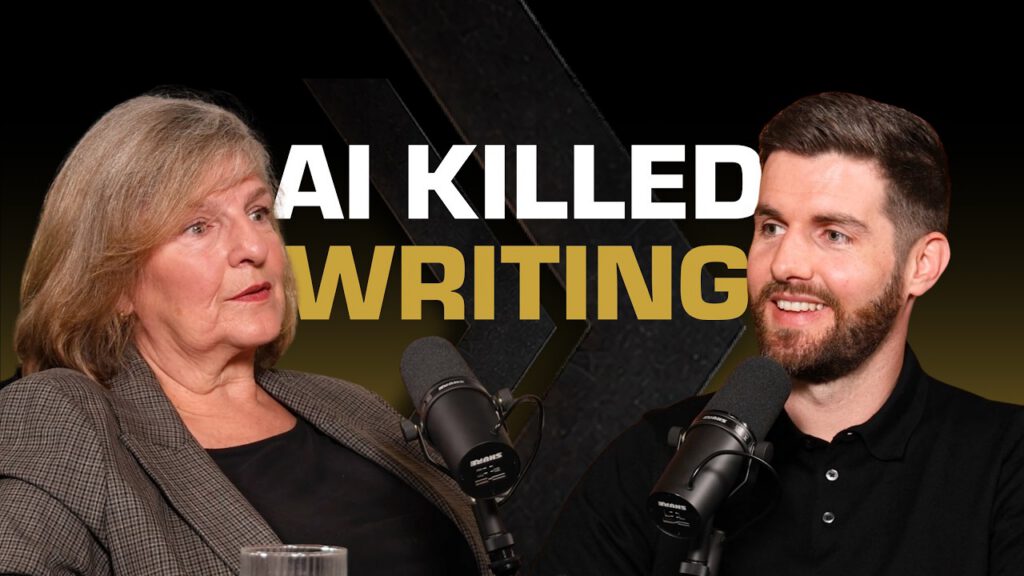
In Episode 10 of Unlocking Business, I sit down with Sarah Mitchell, co-founder of Typeset. Sarah has been a software developer, a technical pre-sales lead, an enterprise software salesperson in Johannesburg and a freelance writer before building Typeset with her business partner Dan Hatch. We talk about AI, storytelling, why most content sounds the same now, and what trade businesses should actually do about SEO.
I’ve done one of Sarah’s workshops myself, and this is one of the most practical marketing conversations we’ve had on the show.
Who is Sarah Mitchell?
Sarah is from Michigan. She spent 10 years as a developer, worked on a big project for IBM in the UK, then moved into technical pre-sales on an international team, flying around 200,000 air miles a year. Wanting to sleep in the same bed every night, she moved to Johannesburg in the mid-90s to sell enterprise software, then lived in France and Malaysia before landing in Perth.
She started her copywriting business, Global Copywriting, in Perth in 2008, the same year the GFC hit, without knowing anybody here. She met Dan on Twitter. Together they started Typeset to focus on writing, editing and proofreading at a standard a journalist would use. Today Typeset does fractional content leadership, award submissions and writing workshops, and Sarah has judged business awards for years.
Key takeaways from the Typeset story
1. Use AI as a tool, not a replacement
Sarah uses AI every day. When an agency sent her a hundred pages of background for a 10-page paper, she put it into Claude and asked for the top five themes, which gave her a place to start. The mistake is taking the first thing it gives you and publishing it. Her rule is that you have to orchestrate it. Treat it like a good intern: useful, but you are still the boss, and you check everything.
2. If you sound like your competitors, what’s left?
When everyone uses the same tools, everything starts to sound the same. Sarah calls it the great blanding of content. Cutting jargon and “gobbledygook” makes your writing stand out simply because it isn’t there. Readers won’t notice it’s missing, they’ll just find you easier to read and keep reading. After her award workshop, my team started doing exactly this: just say the thing.
3. Treat content as an asset, not an expense
When work goes quiet, marketing is often the first thing cut. Sarah’s view is the opposite: when times are tough, showing up is what saves you. Good content aimed at your target audience keeps bringing traffic for years. Paid ads stop the moment you switch them off, while content takes around six months to start returning value and can keep paying off 10 years later.
4. Update old content so AI can read it
You don’t need to throw out your old blog posts. Sarah is working through five years of a client’s best performing articles and making them AI friendly. Turn headings into the questions people ask, answer the question in the first sentence or two, and break things into chunks of about 300 words between headings. Add an FAQ section with a cascading set of related questions. If a page gets no traffic after two or three years, delete it.
5. Build an audience you own
Impressions in an agency report don’t mean much if leads aren’t converting. Sarah says the most valuable thing a business can build is its subscriber list, because algorithm changes can’t take it away. Even more valuable is permission to send mail to someone’s home. Put a handwritten address on an envelope and almost everyone will open it. Sarah also wrote our article on exactly this, Stop renting your leads. Start owning them.
6. Know what you do best, and say no to the rest
Sarah has seen agencies say yes to every request and figure it out later. Her view is that every bad job you take keeps you too busy for a good one, and referring work to someone who does it better builds your reputation. That hit home. Smartfix grew from one ute in 2018 to $30M a year and 130+ staff across a lot of trades, and I’ve since pulled it back to 30 staff and one office.
How case studies sold software in Johannesburg
When Sarah arrived in South Africa to sell Compuware’s testing tools, she found the products were already widely used but nobody knew the company behind them. The software had come in through local distributors during apartheid, much of it unlicensed and out of date. Her job was to get everyone onto proper contracts and sell more. Her whole sales approach relied on a brand nobody recognised.
So she started writing case studies and white papers from her own experience as a developer, with the business case, cost justification and payback period spelt out. They started getting attached to proposals, and deals of $2 million to $10 million began to move. There wasn’t even a name for content marketing yet.
“We’re in this great blanding of content. We’ve sawed off all the rough edges. Everything is very smooth, everything is very professional, everything is very same, same, same.”
Sarah Mitchell, co-founder of Typeset
Where to find Typeset Content
Sarah is on LinkedIn as Sarah Mitchell, and it’s the only social platform she uses now because that’s where her audience is. You can find Typeset’s work on fractional content leadership, award submissions and writing workshops on their website.
- Website: typesetcontent.com
- Sarah on LinkedIn: Sarah Mitchell
More episodes you might like
- Stop Chasing the Newest AI Tool | Sam Fielding
- Marketing, Branding and What Actually Works for Trade Businesses | Aisha Derrick
- Getting the Phone to Ring When Work Dries Up | Steve Leigh
Want help building a business that grows without burning you out? Work with me.
In this episode
- 00:00Intro and welcome Sarah Mitchell
- 01:02Why storytelling matters
- 04:11AI: good, bad or both
- 09:27The great blanding of content
- 14:41What Typeset does and how AI hit it
- 17:49Award submissions that stand out
- 20:57Team workshops and fractional work
- 28:20From software developer to content
- 34:42Freelancing and starting out in Perth
- 37:53Marketing through tough times
- 42:04Making old content AI friendly
- 48:19How to find a real SEO expert
- 54:36Tracking what marketing actually works
- 59:50Content, distribution and amplification
- 1:07:13Paid ads coming to ChatGPT
- 1:11:25What frustrates Kane about agencies
- 1:19:51Personal brands, books and repurposing
- 1:24:04Publishing podcast transcripts
- 1:33:31Lessons: no shortcuts, use experts
- 1:40:49Firing a difficult client
Full transcript
Read the full transcriptAuto-generated from the episode, lightly edited for clarity
[00:00] Cold open
Sarah: I don't want to say it tanked, but we took a big hit.
Sarah: These are not people that we want to work with.
[00:10] Introduction
Kane: Hey, I'm Kane Tyler Smith, the founder and CEO of Smartfix and Hypotential. This is Unlocking Business, where we have real conversations around business, leadership, mindset and personal growth. If you've been getting value from these conversations, please take a second to like, subscribe and follow our channels. It helps us reach more people, bring on more guests and share more stories. Now, let's get into this episode.
[00:35] Why storytelling matters
Kane: Today, we're joined by Sarah Mitchell from Typeset. Sarah, you have a background in software development, sales, writing and content strategy, and now you're helping businesses communicate more clearly through content, storytelling and marketing. Why does storytelling matter more than most people realise?
Sarah: First of all, I haven't always been of the opinion that storytelling was important. I come from a business background, from a software background. It's very often cut and dried information. But I think in the age of social media, in the age of everybody being online now, we connect with stories, we remember stories. There's so much information out there, there's so much knowledge out there, that what we as humans gravitate toward is the story. I'm a huge proponent of it now, because a story can help people remember things a lot easier than they can remember facts, figures, detail.
Sarah: And especially now, with the way that the internet is just a glut of information, we can all get that. But the stories are what connects us with our audience, which makes our businesses sound more human, which makes us feel like, I really like those people, or I don't like those people. Stories bring out emotion, and I think whenever you can tap into your target audience's emotion, you're going to win. So from a writing perspective, it's just way more enjoyable, and you get to add that creativity to it.
Kane: Do you think that means personal branding is becoming more important because of storytelling?
Sarah: I think personal branding has always been important. I think storytelling helps build that personal brand in a much more authentic way. My son is 22, and he listens to all kinds of things that are very different from me, and he has very different interests. He's a complete rev head, so we hear stuff about cars 24/7 at our house. But when he comes to the dinner table at night, if he wants to keep me engaged, he has to tell me in some kind of a story. But if he's talking to his dad, and this is where I usually get up from the dinner table, then it starts to be about parts and the mechanics of it.
Kane: And the specifications and numbers.
Sarah: Yeah, that's exactly right. So I just think that depending on who you are and what you're looking for, the story is still where the connection is. So from a personal brand, the more that you can tell your story, and relate to people through a story, the better off you're going to be.
Kane: Do you think it's more of a buzzword at the moment than personal branding? Because I've seen a lot about it in more recent years than previously.
Sarah: Yeah. In fact, I've tried to move away from storytelling almost, because it has become a buzzword. Everybody talks about storytelling and then they're cranking out this commodity level content, which is a good word for it at that point. And it's like, well, where's the story in it? You can start it at "once upon a time", but for a good story in business writing, I want to see something that threads through the whole thing. I don't want to see the first paragraph be an analogy or a little something that happened to you, and then you just switch right into vomiting all of your information at me.
[04:11] AI: good, bad or both
Kane: That might lead into AI slop, and I suppose there's a lot of that.
Sarah: Yeah.
Kane: What are your thoughts on AI? Is it good? Is it bad? Is it both?
Sarah: Yeah, it's both. I use AI every single day. I think it's got really great uses for some things. If you are just, and I'm struggling to find the word here, which is always irritating for writers, if you are just parking some part of your marketing or your business and relying totally on AI to do that for you, you're making a mistake. So I think, especially as business owners, we need to orchestrate what AI is doing for us and use it as a tool.
Sarah: But I see far too many people that will, and I saw Rand Fishkin just did a survey on LinkedIn, and he's put out one of his little videos about this, people will ask something of AI, or ask it to do something, and they'll take the very first thing that it spits out and they'll publish it without any intervention. And I just think that's a huge mistake.
Kane: You can tell, hey. LinkedIn these days is pretty bad for it.
Sarah: LinkedIn is.
Kane: You can't scroll without saying, that's AI, that's AI.
Sarah: Yeah, and so is Facebook. I assume Instagram is too. I don't spend too much time on any of the Meta stuff anymore. But the other interesting thing is people think they can tell something is AI and it's not. People are really bad at identifying it.
Kane: Yeah, okay.
Sarah: There's been plenty of research on that too. But there are some tricks to writing that writers have always used, and I think the em dash right now has been the flash point with writers. People say, "Oh, there's an em dash. That was written by AI." Well, writers have been using em dashes for centuries, and that is actually why AI uses em dashes, because writers have used em dashes.
Sarah: So sometimes you can tell, sometimes you can't. I think if you've used it responsibly, and you've used it as an aid instead of having it do the work, as an assistant, then yeah, why not? Especially for things like research, for synthesising information. I'll give you a great example. I had a brief to do a paper, and the paper was about 10 pages long. It was an agency that briefed me on this, and they sent me like a hundred pages of stuff. As a writer, first of all, it's going to take me days to go through all that. Second of all, how am I supposed to take all of that information and then find something meaningful?
Sarah: But I can chunk that into Claude and say, "With all of these documents, give me the top five themes." Now I've got a place that I can start. That's where it's really, really helpful, I think. I'm a writer, though. I like to write, so I don't want to give it that job.
Kane: Yeah, give it your job.
Sarah: Yeah.
Kane: I've heard a lot of people talking about Claude recently. Does that seem to be the best one for writing and content?
Sarah: Yeah, 100%. And I've used a lot of them. I started on ChatGPT, and it was never really a comfortable assistant for me. It always felt odd, I was getting odd answers, and it didn't flow for me. Then when Claude came out, I started using that pretty early on, and it just clicked for me. Now I've got a paid subscription. I only use Claude. But I've got clients that use ChatGPT. They'll brief me, they'll run their stuff through ChatGPT and send me the chat brief. To me, it's got a very distinctive style to it, and I don't think it's as fluent as Claude. So I recommend Claude to everybody.
Kane: Yeah, okay. So why do you think people sometimes can't tell the difference between an AI piece and a real one?
Sarah: Because it's getting better.
Kane: Yeah.
Sarah: It's getting a lot better. And you can train it. You can say, don't give me em dashes, don't give me rhetorical questions, don't give me series of three.
Kane: Don't sound like AI.
Sarah: Yeah, don't sound like AI. And you can do that.
[08:23] Will humans start writing like AI?
Kane: I heard something the other day on a podcast that was talking about how AI is learning over time, and from the way it's now writing, humans will then start to write the way that AI does. So it has a reverse effect. I actually use em dashes now. I'd never used them before, but it just feels natural to me, because we've used AI a lot.
[09:27] The great blanding of content
Sarah: That's absolutely right. And I guess that's the risk, that if we now start talking or writing like AI writes, then we've lost our originality. But you see that in a lot of ways. I'm reading that this is happening in the US with the way Trump speaks, which is so distinctive. So now a lot of people have started to speak like him, and to use the kind of language patterns that he uses, both in their writing and their speech. I think it's human nature to emulate something that you admire or that you think is successful. So it's going to happen. But what that prevents is differentiation. Everybody starts to sound the same.
Sarah: I've said it myself. We're in this great blanding of content. We've sawed off all the rough edges. Everything is very smooth, everything is very professional, everything is very same, same, same. And I want something as a reader that's going to stand out, that's going to make me think.
Sarah: The other thing I read yesterday, Kane, that I thought was fascinating, and this was in the New York Times, is that they've been analysing research papers that have come in from students. I can't remember if it's high school or university level, I think it was university level. But they're saying the stuff that's generated by AI is less creative than the stuff that's generated by people that have not used AI. So everything from AI will be correct, and it will be perfect, but there's not as much innovation in the ideas that are coming through. There's not as much creativity in the way things are being presented.
Sarah: And I think that's a big risk to business owners, because if you sound just like your competitor, and they sound just like their competitor, and you sound like the three people that are in the next local community, what's left? Well, what's left is your ability to stand out because you're not using AI.
Kane: I always remember from the workshop we did with you guys for the award submission, you were talking about, I can't remember what it was, things like those top used phrases. The jargon list, and just cut all that. So after that we made heaps of change within our business. Just say the thing. Don't beat around the bush. Just say the thing and just write that. You don't have to over explain everything. I use that for everything now, hey.
Sarah: The gobbledygook? Oh, I'm so glad to hear that. Yeah. And I think AI uses so much gobbledygook, and any AI agent or AI bot is always going to try to make you happy. So they are going to feed you something that they think you're going to like, and if you just accept it, then you're just going to get more and more of that. And quite frankly, the internet is full of awful writing, and it's just populating that. So I think if you can get rid of that gobbledygook, or the jargon monoxide, that's another term that I've heard for it, you're going to stand out just simply because you don't have it.
Kane: Mhm.
Sarah: And the reader doesn't process that, right? When they're looking at it, they don't say, "Oh, wow, look, there's no jargon in here," or, "Look, there's no gobbledygook in here." They're just going to read it, and they will find it easier to read. They're going to internalise the information in it more. They will not switch off as easily. People skim much more than they read.
Kane: I'm a bad one for skimming. I probably skim too much.
Sarah: Yeah, well, we all do, because there are too many things that we've got to do. But if something is really written in an original way, then you will slow down, or you will read every paragraph, or at least you'll keep skipping down the page as much as you can.
Kane: Yeah. I even skip past dot points now. I used to usually always go to all the dot points, but when you speak to Chat or something, it gives you the spiel, then it gives you the dot points, then it gives you more spiel and dot points. And now I just skip to the bottom. What's this little summary at the very end? And then I have to go back and read the parts that I actually need to.
Sarah: Yeah.
Kane: Yeah, it's fun.
Sarah: Reading backwards. That's an interesting observation, because I certainly do that as well. There's that idea that when we read online, we use the F pattern. If you look at heat maps for how people are reading online, they will read the first two paragraphs, then they'll skip a little bit, then they'll read a bit in the middle, and then they start to go straight down. So if you look at the heat map, it looks like an F.
Kane: Yeah, I get.
Sarah: And I know I do that, and I'll do the same. I'll get to the end, and if the information's not in that final paragraph, where do I skip back up to?
[14:41] What Typeset does and how AI hit it
Kane: So what does Typeset do?
Sarah: It's interesting. Since AI, what we're doing is a little bit different. We started in 2019. My business partner, Dan Hatch, is a former journalist, and we've worked together for a long time in content and in writing. We worked together in an agency for a while. We started that business because we were just worn out by agency life. I wanted to, and he wanted to, spend more time on the tools. We're writers, and pretty soon you get to a position where you're managing a bunch of people, you're doing a bunch of BD, you're doing all kinds of stuff in the office, and the people that are doing the things that you enjoy doing are having the fun, and you've just got the drudgery.
Sarah: So we decided we wanted to have this business, and we were going to stick in our lane, which was writing, editing and proofreading. So Dan and I started that business. We've got a proofreader that we've worked with for a long time as well. And we wanted to just produce business content at a level of quality that journalists would use. We can talk about this if you want to, but I honestly believe that the content you're producing is an asset to your company if it's done properly.
Sarah: So we went along swimmingly until 2023, when ChatGPT came out, and within six months our business, I don't want to say it tanked, but we took a big hit. Those six months were challenging, and then it shot back up again. I think what happened is people adopted ChatGPT as a way to do their own marketing, to do their own writing. We had people that told us that, people we'd worked with for years. And then they found out it really wasn't very good. You could do it, but there was a lot of slop out there.
Sarah: Then last financial year it got better, and we had people that had been our customers since way before Typeset just saying, "We're going to produce our own content now, and we'll use you guys for strategic things," because it had gotten better. So we've had to reposition the company into areas, still within writing and within content, that AI can't really do. Dan and I are both working as fractional leaders in that content space. So if it's head of content or managing editor, that's more the thinking that goes in behind what your content and writing programs might look like.
Sarah: Then awards. I've worked with Business News for a long time on the 40under40 and on their WA Business Awards. If everybody uses Chat or Claude to do their award, you're not going to stand out. You might have a wonderful award, but it's a really specific skill that requires differentiation in every way.
[17:49] Award submissions that stand out
Kane: That just reminds me, because when you guys helped with my award in that workshop, yes, you could put all the questions into ChatGPT, but you guys have to get out of me, or the person, our stories, those things that you forget about. That was something that you went through in the workshop. You need, what was the bad thing that happened? Those stories that you need to draw out of the people, so it is their story.
Sarah: Yeah, it is a story. I've worked as a judge on a couple of different awards for a long time, and having sat on the other side of that table, and having a hundred awards that you're looking at, they really do all sound the same pretty soon. And if there's not a story in it, if they haven't been constructed properly, if it's full of gobbledygook, you've actually missed an opportunity to get more value into it.
Kane: Because of the word counts.
Sarah: Because of the word counts, and some of those are really brutal. So we do a lot of work in that area. Sometimes your business shows you where your opportunities are. We wouldn't have gone into a business thinking awards were going to be a thing for us, but over time we've gained a reputation. People keep coming back to us. People refer us. Now we do awards for people all over the world. Part of that's because the marketing is working, between our socials and our newsletter and our website. When people Google "I have an award" or "I need somebody to help with an award submission", we show up. That's why we're doing awards for places in the US where we don't really have any contacts, but they find us.
Sarah: And then the third thing we're doing is workshops. Helping people with their messaging, helping people to write more effectively, helping people to write with empathy, helping people to understand how to differentiate themselves in writing, how to be that human in the loop. If you're going to use AI, fine, but how do you know if it's good or if it's not good? So those three things: the fractional leadership, the awards and the workshops.
Sarah: And we still do blog posts, we still do articles, we still do case studies and white papers. But from 2019 through 2023, our bread and butter was blog posts, and we would do dozens of them in a month. Now we might do one or two in a month.
Kane: Yeah, I get it.
Sarah: So it made a huge impact. And lots of businesses like ours started shutting up. I mean big businesses. I was surprised to hear that people's businesses ended, that they went out of business because of the impact of AI. And I just thought, well, I'm not ready to let that happen. I've got more to say.
[20:57] Team workshops and fractional work
Kane: Yeah, I think, like you guys have done, you've just got to adapt and figure it out, because you still need the human touch at almost every point. So the workshops, are they online or are they in person?
Sarah: They're mostly in person, and mostly at a business level. We haven't quite figured out how to fill a workshop for the public. We've tried that a couple of different times, and we always end up losing money, because you have to rent a room, you have to do the catering, and you have to spend time marketing to get people in. There are a lot of people that are interested, but for people to actually pay and show up is a different story. So we tend to sell those more at the business level. We'll do teams.
Kane: So that's within one business you're running it.
Sarah: Yeah. Sometimes they're really big businesses where there are multiple teams, and sometimes it's just a small business that says, everybody in our business is writing, but we all come at it from a different angle, and we just want some advice on how to be better, and how to get everybody on the same wavelength for writing.
Sarah: My first writing course started when a customer said to me, "I'm spending all of my time editing everybody else's writing, and I've got this diverse group. I've got people that are close to retirement. I've got interns. I've got people that did writing courses or writing degrees. I've got people that have never done any writing." They were a not-for-profit, so they were communicating with government a lot, and she said, "We're all over the place. Can you come in and help us get on the same page?" She was also in the situation where she was arguing with people about what was right and what was not right. Somebody went to school in the '60s and their third grade teacher said, "This is the only way you can do it," and she's like, "But that's not true anymore."
Sarah: So a lot of times we will go into an organisation and get everybody together. It's just a professional development day, and it gets people talking. Everybody writes, but everybody doesn't write the same way or have the same view on what writing should be.
Kane: Mhm. So how is that different to the fractional part, then? Is the fractional part more of a longer term thing with you guys in their business?
Sarah: Well, not really. In fact, fractional for me is a very defined engagement with defined outcomes. The workshops are more like skills transfer, basically. But the fractional stuff, and I'll give you an example right now, I'm working with a customer in the UK, an SEO agency, funnily enough, who, because of the way that search is moving and because of AI, knew that they wanted to have a bigger discipline of content.
Sarah: So they'd been looking for a head of content, and they couldn't find a head of content. The general manager had been doing that management part of it. And the marketing manager just said to me, "Would you be interested in coming in as our head of content?" Well, no, because I've got my own business. "Would you be interested in coming in as an interim?" Okay, I can do that while you find somebody.
Sarah: That started out as just an interim role, but when I came in, I could see things that they needed to be doing that they weren't doing. First of all, they'd had a revolt in their content team. Almost all of their writers were leaving. So the first thing we had to do was build that writing team back up, put in processes, put in procedures, develop assets. They didn't have any kind of way to go to market with content. They didn't have any kind of philosophy. So it was going in and setting all of that up, and I'm still doing it.
Sarah: But what I'm doing now is getting that internal capability built up. When I think of fractional work, that's what I'm looking at: going in and helping a company build the internal capability, and then I exit out. I think if you're there for a long time, it can get political, and I don't want a full-time job. I like working in my own business. But I really like helping organisations build that capability, getting them set up and getting them on their way, and then I go to the next one. And I can do two or three of those fractional things at a time.
Sarah: Sometimes it's a three-month gig, depending on what it is. Sometimes it's a year. But I always think that with fractional you have to have a defined outcome of what you're working towards. Otherwise, you're just consulting. And I think the problem with consultants is that traditionally they like recurring work. They like to bill, but the output doesn't always match. So you're paying somebody to be there all the time, but if you're not using that person all the time, then it's a cost. So I always want to make sure that I'm providing value.
Kane: Yeah, that's interesting. I assume you have set hours per week that you would work for them? Do you go into their office and do that, or is it all remote?
Sarah: Well, the one in the UK is remote, because I'm in Perth and they're in Leeds. In fact, most everything that we do is remote now, because it's just more convenient. But every single engagement is different as well. Some places it'll be two days a week. Some places it'll be 15 hours a month. Some places it'll almost be an order, like, we want four case studies in a month. Or it'll be, develop a content marketing strategy for us, with all the editorial assets that go with it, like the editorial calendars and style guides and the tone of voice and all of that. And then when that's done, it's over.
Kane: Yeah, okay. That's cool. That would give you a lot of variety, wouldn't it?
Sarah: Yeah, which I love.
Kane: Have you done any with the trades and services?
Sarah: I've actually had quite a few trades, more in the awards kind of stuff. I've done some manufacturing. One of my long-term customers manufactures industrial conveyors for powder handling. They're based in Perth. I knew nothing about powder handling when I started, right? I'm an expert now. I can talk all day about powder handling and all the problems that come with it. We do a lot of work in technology, because I've got a background in technology. And of course it's Perth, so you're doing a lot of stuff in mining. So mining, engineering, that kind of stuff. A lot of recruiting, a lot of aged care.
[28:20] From software developer to content
Kane: So how did you change from the software industry into content?
Sarah: It was really interesting. I had worked at the same company in the US as a developer for 10 years, and I was really getting burned out on technology. I had the aptitude, but I didn't necessarily have the passion. What I really liked was the business parts of it. I was contracting, so I had worked in a lot of different organisations where I'd go in for a project or two. I'd done a big project in the UK for IBM, and after that I felt like, and I'm from Michigan, am I going to go back to Ford Motor Company and write test plans? How do you top working on a big project for IBM? And this guy convinced me to come in and work in a technical pre-sales role in the international team.
Sarah: So I spent two years doing that. I was flying like 200,000 air miles a year, because my territory was everything but North America, and I was living in Michigan. I said, "I just need to be in the same place every night." And I knew the guy that was running our South African office. He'd just opened it. He said, "Why don't you come down and sell? You can carry a quota, you can sell, you'll be in the same bed every night. It'll be great." So I did that. That was shortly after Mandela was elected, so this was the mid-90s.
Sarah: I went in with these fantastic products that I'd used as a developer, that everybody in any kind of mainframe environment would use. They were industry standard software. And when I got to Johannesburg, they were being used all over illegally, because during apartheid nobody could sell in there, but things were going in through the distributors. So I had to go in and get all of those contracts normalised. Everybody had to quit using stuff illegally and start using things on a legal contract. They had to get everything up to date, because some of the software was really outdated. That was kind of the mandate: go out and sell a bunch more software, get everybody organised. Great, I can do that.
Sarah: But what I did not take into consideration was that there was no brand awareness at all about the company. People didn't know the company name at all. They only knew the product names, and they didn't know the product names were attached to a company. They thought they were attached to the local distributor. So I went in with this selling model that was always relying on the brand, and now I've got all this material that doesn't mean anything to any of the people that I have to sell to.
Sarah: What I did know, though, was how to use those products in a technical environment. So I started writing case studies and white papers based on my own experience, and that is what started to help me get deals. It was just my personal knowledge put onto paper. They were starting to get into the proposals. And these were multi-million dollar contracts. When you're going into a huge bank and you're selling something that they use every single day, we're talking anywhere between $2 million and $10 million deals. I couldn't get a meeting. But when I said, "Look, here's a white paper. Here's a case study. Here's a cost justification. Here's what the payback period will be," and I could write that all down, they were getting attached to proposals and stuff was getting through.
Sarah: At the end of that, I was pretty worn out with technology. Direct sales, with a commission and big quotas, just did me in. It really did me in, and I thought, I'm out. And that's when I started freelance writing.
Kane: So with the software, was that like CRM systems?
Sarah: They were testing tools for enterprise programmers. Things like how to detect abends, how to find errors in your data, how to run automated testing on large-scale applications, how to debug code. These were just things that people used every single day as a developer.
Kane: So your case study would be how you've used it yourself. That's like the storytelling piece, so they can read it, and that's how you can sell them the product.
Sarah: Yeah. And for somebody that's got a budget, they don't really care if it works or doesn't work, in some respects. I mean, they do care if it works, but they don't care that people really like it, because there's going to be a competitor that does it as well, and if they can do it cheaper, then they're going to take that. But if you can prove to them that it makes sense to use your product, and here's why, here's the business case why, then they'll accept that. That's what I knew I had to do. I had to make a business case, because there was no brand awareness.
Sarah: That's when I really understood the value of brand as well. I went from a company where, in every other market in the world, you'd walk in and you could just get a meeting, because you could say, "I'm from Compuware." I go to this place where I'm now living, and...
Kane: You don't have the brand name.
Sarah: No brand name. I moved my whole life. I'm down there by myself. I don't know anybody when I get down there, and I just had to figure it out. And it was creating that content, that really valuable content that was quite strategic, that my sponsors, who wanted to keep it in, needed, and the people that were making the decisions on those major budgets needed. And it's like, oh, this stuff works. There wasn't even a name, content marketing, for it at the time. And there weren't blogs yet, because people weren't publishing online. Websites were pretty rudimentary. But I was writing for local newspapers. I was writing articles. And journalists loved it, because they didn't put my name on it, they put their name on it, but they would publish exactly what I wrote, because that was one job done.
[34:42] Freelancing and starting out in Perth
Kane: So that's where it started for you, freelancing, and it was for papers?
Sarah: Well, after I left technology, I thought I'd be writing case studies and white papers for technology companies, and I did a lot of that. But I was also doing things that interested me. I was writing for travel magazines. I was writing for airport magazines. I was writing for kids magazines. I was really just doing things that appealed to me. And we'd moved around a lot. We left South Africa and went to France, and then we went to Malaysia. Then we came to Australia, and my husband decided to do a PhD. He's a chemical engineer, so his midlife crisis was, "I need to do a PhD." It's okay, better than a girlfriend really, or a sports car. Which the sports car did end up coming into play as well.
Kane: What car?
Sarah: He got a Porsche.
Kane: 911?
Sarah: He got a Boxster.
Kane: Okay, cool.
Sarah: But he started working part-time and studying part-time, and after a year of a part-time income, I thought, I've got to get more commercial with my business. So I started Global Copywriting, and it's still going. It's just a sole trader. And I really then decided that what had been a hobby now had to be a business, and I had to start setting goals for myself and earning money and bringing that in. But even though I'd worked all over the world, I didn't realise how hard it is in Perth to get started if you don't know anybody. And I didn't know anybody in Perth.
Kane: When was that? When did you start?
Sarah: 2008.
Kane: Yeah, okay. Was that the early stages? When was social media coming around?
Sarah: Well, good timing. It was right about then. In 2008 is when the smartphone came out. In 2008 people started to understand that they needed to have things like blogs. Twitter was a year old. I met my business partner on Twitter, actually. I met Dan on Twitter.
Kane: Yeah, right.
Sarah: And Twitter was how I got to know who people were in Perth. That's how I met Nick Hayes from Media Stable. The early adopters were a lot of people in the creative industries, and there were a lot of writers and things like that. Initially I started connecting with writers, but then I figured out, well, the writers are not my target audience. The writers are my competition. But I started to get referrals on Twitter from people that knew that I was a writer, from things that they'd read.
Sarah: But the other thing that happened, to go back to my point about the smartphone, is I thought I would still be working in tech, but in 2008 everybody wanted blog posts, everybody wanted social media. I did so many social media trainings. This is Twitter, this is what it is. This is what LinkedIn is, this is how you do it. This is what Facebook is. So really, the workshops and that education started just naturally, because I wanted to get in front of people.
[37:53] Marketing through tough times
Kane: Would you say that was perfect timing? Lucky timing?
Sarah: Well, the GFC also started in October 2008, when I did.
Kane: Yeah, okay.
Sarah: But you know what happens when the economy's tough? Your marketing is what's going to save you. That's all you can do if things are really tough. You have to keep showing up. You have to keep being out there.
Kane: That's actually a very good point, because that's what happens with us every year. April and May for us is such a bad time of year, with school holidays and public holidays. It's always so quiet. So in previous years, marketing has been one of the first things where it's, okay, cool, let's just drop. Let's just drop radio. Let's just drop SEO for a couple of months. But you are right. How can you drop the one thing that's going to bring in the work in the first place? It's a hard thing to balance as a business owner.
Sarah: I think people look at it as an expense. So they think, if the cash flow's not great, or if the contracts aren't coming in, then we've got to cut our expenses. But I always look at marketing, especially content, as an asset. Something that's really focused on your target audience, that's providing value in some way, some kind of information or some kind of story that they're looking for, will continue to drive traffic to your website or to your personal brand for years after you've created it. It will continue to keep your Google search rankings high. And if you can do all of that in an organic way, then you can reduce your spend on paid. You can even reduce your spend on technical SEO.
Sarah: And I think the work I'm doing right now with the SEO agency in the UK is because they recognise that for SEO to work really well, you have to have content that supports it. It has to be anchored to something. So I always say to people, a good content marketing strategy will help you move your marketing expense across the balance sheet, and it becomes an asset to your business. And you can tell what's really working, what is driving leads to you, what is building your personal profile.
Kane: Yeah, SEO has always been interesting for us. We've only actually started doing it in the last 12 months, or maybe 18 months, because it is hard to measure. We've always been so heavy on paid Google Ads. So when we have spent on SEO, it's like, if we spend six grand a month, it's so hard to measure what comes in from that. And I know it takes time. It takes six months, 12 months. But we know if we put that money straight into Google Ads, we're going to get X amount of leads from that. We know what we're going to get, but SEO has always been hard. So recently we have stopped doing it through an agency again, because I'm like, how is AI going to actually affect this, and does the agency actually know how to work with AI? It's so confusing.
Sarah: Yeah, and I think that's a good question, because right now, if you go out onto LinkedIn especially, and it's probably the same on X, I dropped off Twitter before it ever went over to X, everybody's an AI expert right now. And it's like, yeah, I remember when you were the crypto expert, and before that you were the social media expert, and before that you were some other expert. So you get these groups of people that kind of roam around, and there's this philosophy that if I'm three months ahead of everybody else, then I'm an expert and I can speak about it, which makes me really uncomfortable.
[42:04] Making old content AI friendly
Sarah: But I think you always go back to your basics, which is understanding who your audience is and what they're looking for, and understanding how Google's working. The people that are winning on AI are also winning on Google search, because as my buddies in the UK say, AI search is SEO. Ultimately, it's just another thing that you have to consider. That can be things like your blog posts should be in 300-word blocks. Your headers should start with a question that people might be looking for in search. The way that you structure them is a little bit different, and you can go out and change your current content to make it more AI friendly, but you don't ever throw out the work that you've already done.
Kane: That actually reminds me of a question I was going to ask you before. You're saying that having that content is an asset, and you said it can last years. If we've got a website now that's got heaps of blogs on there, but it's not specific to how AI works, can we edit that content to update it so that AI can read it? Because I know you mentioned having the question as a title, and then I assume you've got to have the answer there, because of the way that, I don't know, is it AEO or AJO or something?
Sarah: Whatever they're calling it. I said it's like Old MacDonald, it's like the EIEIO sometimes.
Kane: So the long tail answer needs to be in there, because if someone's searching "I want to find the cheapest electrician near me", your answer needs to have some form of solution.
Sarah: Yeah, absolutely. And even for just a basic search, it's always great to go back in and refresh your content to keep it updated. And the other thing is, people keep content on their website that's not performing. If after two or three years it's not performing, just get rid of it. But go in and spend more time on what is. I've got a big project going on with a customer right now where we're going back through five years of content and updating every one of those articles that are high performing to be attractive to AI.
Kane: Yeah, okay.
Sarah: So for example, the title might be something about cooking with avocados. That might be the headline, which is great for a Google search term. But for AI, somebody might say, "How do I cook with avocados?" So we're just going in and changing that heading into a question, and then the first sentence or two after that will answer that question. Sometimes you don't really have to change much at all. And then breaking things up into smaller chunks.
Kane: Why is that?
Sarah: Because AI will scan an article, and if it gets too far, it gets confused. So they want to see it in really small, bite-size chunks. 300 words is about two paragraphs.
Kane: Yeah, okay.
Sarah: So in some cases all the content's still great. We're just adding more headings in.
Kane: Mhm.
[45:13] FAQs and fan-out queries
Sarah: We're just chunking it, as they call it now. That's one of the new terms. Chunking it.
Kane: So in theory, a blog article should only be 300 words, no more? There's no point?
Sarah: Oh, no, it can be 10,000 words, but you should have 300 words between your headings.
Kane: Okay.
Sarah: And that's the other thing with Google. Everything kind of had to be, to use the old newspaper term, above the fold.
Kane: Mhm.
Sarah: The higher up in the article your keywords were, the better. AI doesn't care. They can be at the very bottom. The other thing that people can do to make their current content more attractive to AI is to add FAQ sections on every single one of them. Just put an FAQ schema in there, put three, four, five questions in, and answer those questions. And you can just add something to what you've already got.
Kane: Why is that? Does AI look for FAQs? Does it need to have FAQ as the heading, so down the bottom of the page you've got FAQ, and then you've got the questions?
Sarah: It doesn't have to be an FAQ section, but AI likes the questions.
Kane: Yeah, right.
Sarah: They like the questions. So understand what questions your customers are asking and put those in there. The other thing is these things called fan-out queries. You don't want just five disparate questions. You want one question, and then, you'll know how people search on AI, because this is how we search. You might ask a question like, "How do I cook with avocados?" Then the next question might be, "Can I bake a whole avocado?" And then, "Do I have to cut the skin off the avocado before I bake it?" So it's like a cascading list of questions. That's what they like.
Kane: Yeah, right.
Sarah: So that's how you would do it. And by having an FAQ section, you can go in and just add that to the bottom without having to go in and unpick everything before. You can leave everything else the same.
Kane: Mhm.
Sarah: And just add to it. That just continues to increase the value of the content that you already have, and keeps that, as I said, as an asset. Keep investing in the asset you've already got. I see people that throw stuff out and then just make new. It's like, how about just updating the stuff that you've got?
Kane: So you mentioned before, the stuff that isn't performing well, just get rid of it.
Sarah: Yeah.
Kane: So don't even try to rewrite it, because obviously it's not worked for a reason.
Sarah: Yeah. If nobody's getting there, if nobody's looking at it. And Google rewards that kind of behaviour. They're like, you're keeping your website really tight, you're keeping it really clean. They don't like to crawl stuff that's just hanging out there doing nothing.
Kane: We've got that issue at the moment. Our Hypotential website, for example, has got loads of pages from the testing process, but we didn't remove them. And that's actually a question for the Smartfix website at the moment. We tried to have landing pages for every service, for every suburb. And obviously when we made them, it wasn't fresh content for each page.
Sarah: Duplicate.
Kane: We used AI to try to not have duplicates, but obviously it's very close to duplicate. So it has cannibalised the website in a way. But for user experience, if someone searches "plumber in Manning", their best experience is going to that landing page. So we're trying to figure out where we draw the line. Do we just get rid of all those pages that aren't performing? What's the cutoff line? If someone is in one of those suburbs, what page do they go to? It is quite a hard one.
[48:19] How to find a real SEO expert
Sarah: It is, and I think that's why having a technical SEO expert is such a good idea, just having somebody that you can ask.
Kane: It's so hard to find experts. Like I said before, everyone says they're an expert.
Sarah: Yeah.
Kane: What's your opinion? How do you find the expert?
Sarah: Well, first of all, go out and look at what their personal brand is. Are they publishing? Are they actually putting things out there that people can comment on? Are they presenting at conferences and events? What are they publishing? If they say they're an expert on SEO and they've got nothing that I can find that they've written, then it's like, well, how do I know? Because the problem with SEO, and technical stuff in general, is it's not regulated. Anybody can say they're an SEO. I can say I'm an SEO.
Sarah: In fact, my Global Copywriting blog was named one of the top SEO blogs in, I think, 2012, by Search Engine Journal. It's true, but 2012 SEO is way different to 2026 SEO. 2012 SEO was just on-page optimisation, like putting in links and headings and keywords. Now you really need to understand how websites work, how Google works, how the AI works. You need to understand how the back end of those things works, and that, to me, is a specialisation. So I look for people that are writing about it, people that have won awards for it, people that are speaking at conferences about it, because they're putting themselves on the line then.
Kane: Mhm. That's very interesting, because that goes back to the earlier point. Personal branding is probably one of the most important things then, because that person is putting themselves out there. Then you can find them. For example, if they're on a podcast and you come across that, you build that trust with them, hey.
Sarah: Yeah. Like this SEO agency that I'm working with in Leeds. Dan Taylor, who's their chief innovation officer, is an amazing guy. He understands SEO like nobody I've ever met before, and he is speaking all the time. He's developing his own tools. He's educating people. He just understands it really, really well, so I trust him. If I have a question, I'll go ask Dan, if you can ever find him, because it seems like he's always on a plane somewhere or he's got his head down. I'll send him a Teams message and I get these answers back, and I know it's like 2:30 in the morning for him. I'm like, "Dan, what are you doing?" He's like, "Oh, I'm in the middle of writing this tool to help our customers," blah, blah, blah.
[51:27] Content versus paid leads
Sarah: But their whole agency has got a practice of technical SEO, and they've been doing it for 11 years. That's the other thing: staying power. How long have they been in business? Who are their customers? Who are their references?
Sarah: We've lost a lot of business to SEO agencies, for the reason that you said earlier, that I can turn those ads on and I immediately get leads, whereas content marketing is more of a slow burn. You have to build that base of content. It has to have time to rank. People have to find it. So it can take six months before a content marketing initiative really starts to return any value. Now, once it's going, it's like a runaway train, right? It can still be returning value to you 10 years later. But if you are in need of a certain number of leads this month, then it's the SEO people that you go with.
Sarah: And the SEO people will always sell against content people by saying, as soon as we turn this off, your leads are going to stop. But the reverse of that is true too. If you've built your content assets in a strategic way, you can turn it off and you never have to spend money on any of that again.
Kane: Mhm.
Sarah: And I have big customers that say that groundwork we laid 10 years ago, and I helped them write those strategies, I helped them build their content teams, they're off and running. They're laughing. But it's a slow burn process, and you have to drip feed it. You have to keep at it all the time. You can't just do it and then forget about it.
Kane: I'll ask a question you might not know the answer to, because it might be more trade specific, but do you know what percentage you should be spending on marketing? Like a percentage of your revenue?
Sarah: It depends. It really depends, I guess, on what your goals are.
Kane: We've always been so heavy on Google Ads. So I just thought I'd ask.
Sarah: I mean, what's your return on investment on that?
[54:36] Tracking what marketing actually works
Kane: It's hard to say. We have some data for some campaigns specifically. We've done some radio, we've done obviously a lot of Google Ads, we have done some SEO over the last 12 months, and flyers.
Sarah: Yeah.
Kane: Print media flyer drops have been one of our highest return investments we've ever done. I think it's because a lot of people don't really do it anymore. I know obviously real estate agents do, but not really other trades. And because we had so many trades on there, up to 15 at one point, there's obviously a high chance that the homeowner's going to need something done.
Sarah: Yeah, and I think the big mistake marketers make is that they don't keep track of that data. They're not keeping track of their analytics. They're not calculating what that return on investment is. And I get it, right? You're running a business, you've got lots of other things to do.
Kane: Especially in trades, where you're not that way inclined, for the technical side or the data. I think we have pretty good data compared to a lot of trades businesses, but probably nowhere near what we could have. With the proper CRM, it would probably save us millions if we had accurate data.
Sarah: Yeah. And I think the flip side of that is we've got so much data, so it's knowing what data is the right data. I'll give you a great example. We lose business to SEO agencies, but we also win business because of SEO agencies, where people on several occasions have come to me and said, "Every month we meet with our agency, every month the reports show everything is on the up, and yet I'm not converting any more business." So I think it's an easy thing to show, like, impressions. Well, so what?
Kane: Right. They're going to show you impressions.
Sarah: Yeah, so what? What does that mean effectively to my business? How many of those things convert? I'm always interested in the conversions, and understanding what a conversion is. With content, you're not going to write a blog post or an article or a landing page and sell something. But you might get somebody, and this is where I think the real value of content is, to subscribe to your newsletter. Now that subscriber has given you permission to market to them directly, and that doesn't cost you anything, unless you're hiring writers or something, but even then it's a much lower cost. So building that subscriber database is the most valuable thing any business owner can do, because you own that.
Kane: I was going to say, I've heard that recently. That's your owned audience, whereas your social media following, obviously you can lose them.
Sarah: Yeah. Google and all of those social media platforms change the algorithm, and they change your business.
Kane: Yeah.
Sarah: Right? But with a subscriber list, they never do. So that email subscriber list is the second most valuable kind of marketing asset you can have. But the most valuable is having people's names and addresses, being able to post something to their house. That level of trust, that they've given you their phone number and their home address. But you may never have to do that.
Kane: Awesome. Give me an example of that. For someone like us, as a trades business, how's that different to a newsletter? As in, you've been to their house before, is that what you mean?
Sarah: Maybe you've been to their house before and you've got that in your database, but they've said, "Yes, please send me mail to my house."
Kane: Yeah, okay.
Sarah: "I'm happy that you know where I live. I'm happy that you know how to call me." And definitely, if you've been to their house, I'm hoping that you're keeping that database really tight.
Kane: I've never thought about that. I wonder if we could do that instead of an email out, because our email outs don't seem to get the best responses. But maybe we can send physical letters. That could be a point of difference.
Sarah: Well, absolutely. And I'll tell you what, if you send anybody a handwritten letter, it's almost a 100% guarantee they're going to open it.
Kane: Handwritten?
Sarah: Handwritten, yeah. If you get an envelope in the mail and it's got a handwritten address on it, don't you open it?
Kane: Oh, yeah. 100%.
Sarah: You could hire a bunch of interns to just address them, and you could put a flyer inside. But you said flyers already work.
Kane: Yeah, so we do bulk flyer drops. We use delivery companies that go out and do the letterbox drops. From the data that we found, I could go, "Let's do like a million every month," but there's obviously not really enough houses in Perth to do that kind of quantity.
Sarah: Yeah.
Kane: So we just have to stagger it, do it over time, and change our messaging each time.
Sarah: Yeah, and I like that, because, as I told you before we started, we just finished a renovation and we're in the middle of another renovation. When you need your gutters fixed, all of a sudden, I said to my husband, "Do they just drive by and look at all the houses with terrible gutters and put it in? Or is this just serendipity, that it just happened to come when I needed it?" You've got it in your hand. That's going to save me a Google search.
Kane: Mhm.
Sarah: Because I think with Google, sometimes the people you find are the people that have the best marketing, not the people that are the best tradesmen. But now somebody's invested in that.
[59:50] Content, distribution and amplification
Sarah: And I think that's the part that people don't think about, especially with content. If you look at content marketing, it's when you've got that high-value content plus your distribution. That could be email, that could be your flyers, that could be how you get things to people that you know about. And then the amplification, which is your SEO piece. That's getting things to people that don't know about you and that you don't know about. And that's PR as well. When you've got those three parts working together, the content plus the distribution plus the amplification, your marketing costs are going to go down and you're more likely to have a long-term asset. But a lot of people go straight to the amplification, because advertising and PR have been really successful for a long, long time. And sometimes that's the option because, I've got the money, but I don't have the time to invest in all the rest of it.
Kane: Can you explain PR for a dummy?
Sarah: Public relations. Public relations generally has been helping businesses get into the media. Get in front of the newspaper, get in front of the radio, or get in front of TV. That PR model has always been one that requires long-term relationships. There's a lot of power behind it. Good PR agents have good relationships with all of the media, and then they have their clients, and they've kind of been the gatekeepers for media.
Sarah: Social media broke that entirely. That's why so many people loved it, because now I can go to market. Now I can go out and have my own Instagram page, and I can tell everybody everything that I want to. I don't need to have PR. I can contact journalists directly on Twitter or X, or I can pitch on LinkedIn to somebody. I can build my own personal networks and circumvent that. So PR is a struggling kind of business right now, because so many people have gone around it and done their own.
Sarah: And then you get people like, I know you're working with Nick Hayes at Media Stable, and Nick's whole model is, let's just connect the media directly with the experts, because the media doesn't particularly like having that gatekeeper there either.
Kane: Mhm.
Sarah: The journalists are doing more and more of their own work now, because news operations are shrinking to nothing. Newsrooms used to have hundreds of people. Now they might have dozens of people. They just want to get directly to the expert. And once you have the relationship with the journalist, whether it's radio, print or TV, then they're going to remember you, and then you hold that relationship, not somebody in the middle that you're paying money to every month.
[1:02:30] Is PR still important?
Kane: So do you think PR in general is still important, then?
Sarah: Yeah, I do think it's important. I think it's important for people to represent their business. But the thing that people have to remember is, what kind of media are you doing, and is your audience there? A lot of people like to get on the morning news programs, the TV programs, whether it's the Today show or Sunrise or whatever it is. That's great. But are the people you're trying to sell to watching Sunrise? Because a lot of people aren't anymore. Or are they watching YouTube, and should you be investing your money there? So I think PR is important, especially if you've got your messaging right, but it's just so fragmented now. It's harder than ever.
Kane: I suppose the best is just to have a combination of as much as possible.
Sarah: Mhm.
Kane: YouTube, social media, some PR.
Sarah: Yeah.
Kane: I suppose the PR thing, I think that's important, because it gives you that authority. If you are on the radio or on the news and you're talking about either your story or a specific topic, it just shows that you are that trusted person in the industry.
Sarah: Yeah, and you're getting somebody at a different time. They're not necessarily Googling you, but now they've heard you, you made a lot of sense, they relate to you, and they're going to either write down your name or remember your name. I'll remember where I heard it, and then later I'll think, "Who was that guy who was talking about plumbing on Sunrise or on the ABC or whatever?" And I'll go out to the platform and find the clip.
Kane: Mhm. I suppose that will lead into, if they're on other platforms, then you might search their name, and it's like, "Oh, he's been on that as well."
Sarah: Yeah.
Kane: He's on that podcast or something.
Sarah: As long as it's good. I think PR people will say any news is good news, even bad news is good news. But I think for business owners, we don't want to be associated with bad news.
Kane: Is that true? What is it? Any publicity is...
Sarah: Good publicity.
Kane: I don't know.
Sarah: No, I don't think so. Depending on what your business is, you want to always be in a good light. And I think most business owners really have a desire to help people, or else we wouldn't be in business.
[1:04:50] Choosing your platforms
Kane: I feel like a lot of people in trades businesses don't want to show themselves. They're sort of hiding behind the business. Do you think that's true?
Sarah: Yeah, could be. My son's a tradie. He's an automotive mechanic. But if you wanted to scale, if you wanted to expand into another region, then I'd say crank up your marketing.
Kane: That is true. I suppose it depends what you actually want to do.
Sarah: Yeah. And people say, "Oh, do I have to do all of these social media?" No. At one time I was on all of them. Now I'm only on LinkedIn, because that's where my audience is. That's where I get the most return on my investment. That's where I'm not being driven crazy by the toxicity that a lot of these platforms have turned into now.
Kane: That is true. It's something that we've been talking about a lot. We're trying a lot. Do we just go on all of them, just in case? But it can take so much focus away from the one or two platforms that do work for you.
Sarah: Yeah.
Kane: But I suppose for someone like us, we don't really know what works yet, for Hypotential specifically. So I think we just try them all, and then maybe we pull back and focus on a couple in particular.
Sarah: I always recommend that people experiment. And I think with AI, it's just get out there and use it. Experiment. See what is working for you. Figure it out. It might not be anything, but time and again we've seen with technology that early adopters reap the biggest rewards.
[1:06:40] Paid ads coming to ChatGPT
Kane: That just reminded me. I was going to mention it earlier, when we were talking about Google Ads and AI overviews and stuff. You're saying that ChatGPT has now got paid ads?
Sarah: Of course it does. Yeah, they're all going to have it.
Kane: It went live, I think, yesterday or today in Australia.
Sarah: They're all going to have it.
Kane: How's it going to affect Google? They've never really had a competitor in the paid ads space.
Sarah: Not really. I mean, Facebook and LinkedIn, the socials, have given them a run for their money, but AI has fundamentally changed how people search for information. There's a perception that everybody's now using AI to do their search, which is not true. The majority of people are still using Google. But the people that use AI, who are not the majority of people on the planet, prefer to do their searching in AI. So it's going to become a bigger and bigger piece.
Sarah: As these companies get more and more commercial and grow more and more, more people will be doing their searching inside of the AI agents, and Google's going to lose. And I don't think Google's necessarily been such a great player either, because they will say, "Our goal is to deliver the best search results for our customers by rewarding high-quality, high-value content." Okay, well, I'll go out there and do that, and I've been doing that for 20 years. That's great. But then somebody like you can come and pay them to rank above me with my keyword, and you can do it just like that. So now people are frustrated, because I'm not seeing the unpaid search results first. I'm seeing a page of paid search results, or I'm seeing all these different kinds of ads, and if I scroll down, then maybe I'll see this stuff.
Kane: Mhm.
Sarah: But people don't scroll either. I remember we used to say you have to be on the first three pages of a Google search result. Three. Nobody goes to page two anymore.
Kane: I don't know if I've ever gone to page two.
Sarah: Yeah. So I think Google in some ways has shot themselves in the foot by trying to be all things to all people, whereas AI has had two years of a no-ad environment. So we've all gravitated towards that. We love that. But if OpenAI is doing it with ChatGPT, then Anthropic's going to be doing it with Claude, and Perplexity, and Musk will be doing it with Grok. It'll be a matter of time.
Kane: It'll be normal. It depends on which platform you choose to use.
Sarah: Yeah. Just like YouTube.
Kane: A variety.
Sarah: Yeah. And a tip that I've got, and this is from Dan, my business partner. He uses ChatGPT. He likes ChatGPT. He uses it a lot more than me. One thing that you can do, if you are creating content with an AI, whichever AI you're using, is take that result and feed it into a different AI and say, what's good, what's bad, what should I change, does it sound like AI? When we were repositioning our business and coming up with messaging, I said to Dan, "Look, I've been using Claude, and this is where I've landed." And then he took that and chunked it right into ChatGPT, and ChatGPT said, "Yes, no, maybe, this is better." So it accelerated our discussion on how we're repositioning our company. But we had two advisors with maybe competing interests, I don't know. Neither one of them knew we were doing it together.
Kane: I'd say they obviously know it's been communicated across somehow.
Sarah: Yeah. Oh, I think we're quite honest about it. Dan would send me stuff and I'll put it into Claude and say, "This is what ChatGPT is telling my business partner. What do you think?" And for the most part, they're pretty close, but they both obviously had to find something they could agree on.
Kane: That is clever, hey. I should turn the tables.
Sarah: Yeah.
[1:11:25] What frustrates Kane about agencies
Kane: Is there anything you want to speak about that we haven't spoken about so far?
Sarah: Yeah, I'm always curious. I'm sitting in my office and I'm writing most of the time. I work from home. Writing can be a really lonely profession, and that's something that I like about it. But one of the things that I'm always interested in with potential customers is, what is it that you find frustrating about working with service providers?
Kane: Like tradies?
Sarah: Tradies, or as a business owner. Where are you finding the friction? What would you change, I guess, is what I'm asking.
Kane: To be honest, you made a good point earlier about marketing and SEO. Every month they'll come to you with a report on what's happened this month, and it's always like a 2% increase here. We've used a lot of agencies, and it's always been like that. For someone like me, as a tradie that doesn't have that expertise, I'm like, I've no idea what you're showing me. This is good, this is good, this is up from here to there. And I'm like, we've had no more leads. What you said is literally bang on. That's always been an issue for us, especially with SEO. That's why we've never really done it.
Kane: The amount of times I've heard, and I know it's true, "Yep, six to 12 months, you've got to do it." And I know it is a bit of a sales pitch in a way, because it's obviously recurring for them, but it is also true. But then if we use that money for Google Ads, I know what we can get. But now it hurts us, because, as you mentioned before, it's a slow burn. For example, we stopped paid ads for plumbing specifically maybe eight to 12 months ago, and we still get leads, which for us is amazing. So I'm like, oh my gosh, imagine if we did SEO from day one for electrical and air con. How many leads would we get a week? Could we have no Google spend? So we've sort of shot ourselves in the foot in a way.
Sarah: Yeah.
Kane: But yeah, it's probably the explanations from service providers to me as a tradie. I think people try and bamboozle you sometimes if they're trying to sell you their product or services.
Sarah: Yeah, it's really interesting to me, and I'll be the first to admit that our marketing could be much better than it is. We rely on word of mouth, and that's a really comfortable spot to be in. There's nothing better than somebody saying, "Go talk to them, because they've really helped us out." But then when we're looking at ramping up, so many times we're trying to put out information that we think is valuable, but the question is always, is this landing? Is somebody else going to pick this up and believe it? What do you think is the best forum or the best way for somebody to reach a tradesman, for example? Because you guys are busy, and I can always see where there's room for improvement or where something would help. But how do you get that share of mind?
Kane: Mhm. Like how they're thinking, kind of thing.
Sarah: Yeah, how are you thinking, or how do I even get your attention? We're all inundated with marketing. What makes you stop and think, "Oh yeah, maybe this is something that would work for me"?
[1:14:50] How tradies choose who to call
Kane: We always look for referrals. When I'm looking for things now, it's always a referral first. Sometimes I won't even get multiple quotes. I'll just go with that person, because I know that person's been recommended. But I think that comes back to, if someone does a Google search for "electrician near me", we're hoping to pop up as a paid ad, because we're used to that, but we also want to pop up organically through SEO as well, because they've seen us there. They might have heard us on the radio, might have heard me on the radio as part of my personal branding attempt.
Sarah: Yeah.
Kane: So, I've heard of him, or I've seen him. Or they'll do a search on Smartfix specifically, and then they might see my name there, because I might have that authority. I might be a trades and services expert. So they might have to see us four or five times before they actually go ahead and use us for anything.
Sarah: Yeah.
Kane: Trades is hard, because if you use us once, you might not need us again for a year or two years.
Sarah: Especially if you do your job.
Kane: Yeah, exactly.
Sarah: Fixed all the problems.
Kane: So it's hard to get recurring, repeat work off one person. So we do need a high quantity of inbound leads, new leads, and existing when possible. But I suppose for Hypotential, which is the business coaching for tradies, that's a different business model, which is recurring, like it should be. It's a monthly membership. There's a three-monthly stint. So in theory, and I've not got this far yet, but in theory it should be significantly cheaper advertising, because we don't need as many people, because they're recurring.
Sarah: Yeah.
Kane: But then to get those people in, you need to have the content on there. No one is going to come to me now with nothing online.
Sarah: Yeah.
Kane: So for us, we have to do as much as we can. We've just started doing social media. Obviously the podcast is part of it. It's to try and build that authority, have those conversations.
Sarah: Yeah.
Kane: And I have started doing some of the PR stuff. We've done a few radio interviews. It's just trying to put yourself out there. Obviously the 40under40. Hopefully that helps.
Sarah: Yeah. What kind of marketing do you respond to, though? I'll give you an example. I bet I get a dozen emails a day from people trying to sell me writing services. Well, dude, I'm a writer. What you're basically saying is you're competing with me. I never even open those emails. And I just think about all of the time that somebody has wasted. Now a lot of it's AI. You can tell it's AI. But it's like, you don't understand your audience. You don't understand what you're pitching. I know you're trying to get my attention. So what kind of marketing do you respond to, or do you think tradies in general respond to?
Kane: Yeah, I don't read emails either. I'll read some newsletters that I have gone out and specifically subscribed to. What comes to mind is just paid ads.
Sarah: Paid ads.
Kane: Yeah. If I do a search and there are paid ads there, I'll look at reviews. Reviews are important to me. I'll look at their review rating. I know they're paying a lot of money to be there as well. Sometimes I will do a bit of a scroll, but my only concern with the SEO results just below is, are they still active? Because this could be SEO from two, three, four years ago. For us, I know who our competitors are, the people who are always there. I know they've been there for such a long time, so I'm like, "Ooh, are they actually going to be available?" But with paid ads, I know if I call them and they don't answer their phone, they've paid a lot of money for that. So in theory, they should be all over their marketing. They should be all over their customer service, because they're paying top dollar to be in that position.
Sarah: Yeah.
Kane: But also, that's going to come at a cost.
Sarah: Yeah.
Kane: So for me, it's more about convenience. If I want something done at my house, I do a search. There'll be two or three there. I'll look at reviews. If I've heard of them before, I'll call them. They should answer, because they're paying to be there. But I know I'll probably pay a premium for that service as well.
Sarah: So you do pay attention to paid ads as a consumer?
Kane: Yeah.
Sarah: As a business owner, that's so interesting to me, because everybody I talk to says nobody pays attention to paid ads. Nobody clicks on those links. But my take has always been, they must, because otherwise nobody would buy them, right? If you say nobody ever clicks on a paid ad, that's not true, because obviously they work, or people wouldn't be doing it.
Kane: Mhm. It's expensive. It's very expensive.
[1:19:51] Personal brands, books and repurposing
Sarah: Yeah. We were talking about personal brand. What do you think is the value of a personal brand? Is that something that influences you when you're making purchasing decisions?
Kane: It definitely does now. The first time I heard about this was from Diary of a CEO, when Daniel Priestley was on there for the first time. He was talking about it, and obviously he's a personal brand for his business. They do business coaching and book magic and all these different businesses. It's very clever, the way that he goes about it. So this only came to me after watching that, and then I'm like, well, Steven Bartlett, he is his own personal brand. And you start looking at other people, like Joe Rogan and everyone else. They are their own personal brand, and anything they talk about is like a product to sell. They'll have their branded drinks there, their supplements, and I've bought stuff before. I've seen them talk about a product and thought, I'm going to try that.
Sarah: Yeah.
Kane: So anything that they say, I will probably give that a go.
Sarah: So that product endorsement from someone that you trust is important.
Kane: Definitely.
Sarah: See, I'm like that with books. I'm a sucker. If somebody's written a book, especially if it's somebody that I like, or I've listened to their podcast, I'll buy it every time.
Kane: That's huge. Almost every person that goes on Diary of a CEO has written a book.
Sarah: It's kind of like the new hot ticket. You can get a lot of PR with a book. Anybody that's tried to write a book, though, knows how hard that is.
Kane: I can imagine.
Sarah: But I also know people, and I think this is an opportunity for tradespeople too. If you're an expert in an area and you're creating really good content on your website, if it's a blog or a landing page, but primarily blog, if you're writing articles that address a problem that you're seeing with your customers all the time. I think this is so clever. I've seen people take those blog posts, and that becomes the book.
Kane: Yeah, right.
Sarah: They plan it out so that every article is like a chapter. They've almost outlined their whole book, and then in a year they will have a whole book. They'll take those things that are already free online, package them up, get them edited and then publish that book.
Kane: Yeah, right.
Sarah: And then they make that into a podcast. I think that's where there's a lot of value, if you can repurpose the stuff that you've got. I think too many businesses will say, I've written that blog post, that's done, and now it's gone to the side. Or, I've written this case study, I've had this white paper commissioned. You can break that thing up.
Kane: Mhm.
Sarah: You can make multiple blog posts, you can put out LinkedIn posts, you can put out Instagram posts, you can continue to use that. And then if it's still evergreen content, six months from now bring it back out again, because the people that saw it the first time are almost certainly not going to be the people that see it the second time, because of the way the algorithms work. Even with your newsletter, you can repeat topics, because your subscriber list grows. And with a really good newsletter, 10% of people will open it. That means 90% of the people didn't open it. But maybe six months from now, with a different heading...
Kane: Mhm.
Sarah: ...a different subject line, somebody else will open it. So I think we look at content too much as a treadmill you can't get off, when what you really should be doing is looking at it as an asset. How many different ways can I use it? How many different ways can I squeeze value out of it? What do I need to do to ensure that it keeps driving value to my business? And if that means updating headings, or putting an FAQ in it, that's really important, because content is expensive. It takes time. You either have to take your own time, and it takes you out of the business, or you have to spend money to get somebody else to do it.
Kane: Mhm.
Sarah: A lot of it's like our tools. We're always going to keep those in good shape, but the content, not necessarily. We're going to let that get old and wither and die.
[1:24:04] Publishing podcast transcripts
Kane: I've been watching a lot of, I don't know if you've seen him, Matt Gray on YouTube. He talks a lot about the content waterfall, where you can take a topic, like one big article or a podcast, and then you can break that up into, I think it's 27 different pieces, and then obviously you can reuse it.
Sarah: Yeah, absolutely. And I think the podcast is a great example. I hope you'll do this: you take the transcript from the podcast and you publish that on your website, because there are some people that will never watch a video or listen to the audio, but they will read it. And the other thing about podcasts is it's such an intimate medium, and people really love it. It's super sticky, so I think you're really smart to do that. But the audio doesn't get into the Google searches or the AI searches. If you transcribe it, and there are all these AI things that can do that, we use something called Rev, rev.com, you just put the audio in there, and it chunks out the whole transcript.
Kane: Almost like an article, kind of thing.
Sarah: Yeah, and then it's an article.
Kane: Yeah, right.
Sarah: And I think the smart way to do it is just to put it right in your podcast show notes. Here's who was on, here's what we talked about, and then you say, here's the full transcript. And it's content that you can use.
Kane: Write that down, Riley.
Sarah: Yeah, rev.com. And as somebody that likes to skim, sometimes I can't sit still and listen to a whole podcast. But if I know you're talking about something I'm interested in, I will search that and I'll find exactly what I want. So that's another way to boost the content. You're boosting your SEO.
Kane: Paragraph chunks with titles.
Sarah: Yeah, absolutely.
Kane: We have been told that it does listen to the words, and it uses the words as the transcript without having it physically written down. I don't know, again, that's what we heard. So if we have the YouTube link on the website page, it will crawl that audio.
Sarah: But it doesn't render it as easily as text, though. Text is easy. And we interview people a lot. That's a really great skill to have, which I'm sure you're discovering, being able to sit down and talk to people and ask questions. A lot of the content that we're doing is that interview kind of thing, where it's, we've got subject matter experts in our business, can you come in and interview them and write up an article? Yep, we can do that. AI can't do that yet. AI can't interview a person.
Sarah: Would you record the interviews? Well, we always record the interview. It used to be that we would transcribe them ourselves, which takes a long time, but now we're using Rev, it's just rev.com. We put the audio interview in there, and the AI is so good now that it's almost word-for-word perfect. We get it back, and they charge something like 2 cents a minute. So if you've got a 30-minute interview, it's pennies, and you've got this transcript. That's a really great way to help improve your SEO as well.
Sarah: But the other thing is you can start to look for themes. Maybe you want to do a post on newsletter marketing. You can go and look at every single podcast, and where there was a discussion about newsletter marketing, you can pull out those quotes, and now you've got a compilation. So that's just another way to slice and dice it.
Kane: Yeah. It's almost like a history.
Sarah: Yeah.
Kane: All your history put together. You can essentially put that into a Claude project. Is it Claude Projects in Claude, or something? Because I use ChatGPT, and there's a project in there where you can have all your information.
Sarah: Yeah. You know, I didn't even think about that. You could just put it all in Claude and say, pull out all the information about where we talked about paid ads.
Kane: What I've been doing is, when it goes on YouTube, I'll paste the YouTube link into it and say, "Can you give me some feedback on how I went with this podcast?" Obviously I take it with a pinch of salt, but it does give me some very good pointers on how to train myself.
Sarah: Yeah, that's fantastic. There are so many different ways that you can use it, and I think we're just at the very beginning of understanding how it can be useful. But for me, the thing about AI is that you have to be the one that's orchestrating it. To me, it's just like a really good intern, but you still have to be the boss of it.
Kane: Proof everything.
Sarah: Yeah. Proof everything, and don't accept that everything they say is the truth. But if you can drive it to help you, you don't need a virtual assistant. You can get AI to do almost everything for you now, and that's where it's really valuable, I think.
[1:29:50] Do trades still need an SEO company?
Kane: So do you think trades businesses like ours still need to use an SEO company?
Sarah: Well, I think in the beginning, probably yes, if you're just getting started. But if you've got the nerve for the long-term, slow burn method of marketing with content, then within six months you'll start to see some results, and within 12 to 18 months you'll have your own earned media platform that you've grown yourself. And you can get away from that dependence on it.
Kane: Mhm.
Sarah: But like I said, you have to be committed to high-value original content, distributing it through the newsletters or through letterbox drops or however you do that, and then amplifying it. You have to have those three pieces working together. And the amplification then is not paid SEO. It's making sure that your stuff is optimised. You've got online optimisation, you're using the right keywords, you're keeping the stuff fresh and up to date.
Kane: That's obviously a good point. Do you think AI is good enough to tell you what you need in those areas, or do you think that's where you need the expert technical SEO person that can make those decisions?
Sarah: AI is definitely good enough to assess the content. I think where you need a good technical SEO person is on your website and in the back end, making sure your tags and taxonomy are set up properly, making sure your navigation is right, making sure your user experience is right. That's where I think SEO is a really effective spend. But that shouldn't be, open your wallet and spend $5,000 to get leads. That should just be making sure that your website, which is also an asset, is operating at peak. Just like one of your vehicles, you're going to get that thing tuned up all the time.
Sarah: We have a guy who did our website, who's a developer as well as a designer, and about once a year we just have him go through it all. And now we've got cyber insurance, because some of our customers are asking for that, and the cyber insurance company is going through our website and saying, "Here are all the faults, and if you don't fix them, you either pay more or they won't reinsure you." So that's made us even more persistent in making sure that the back end of our website is up to date.
Kane: Is that because of a login? Is that where the cyber thing comes in? Your customers log in to your website?
Sarah: No, we don't do any kind of e-commerce or anything. But we have a newsletter, so we have people's email addresses come through it. And the cyber insurance will say, for example, you've got an old piece of software that needs to be updated, you're using an old WordPress, there's some code that has been put in there that is now a threat. It seems like they can find something new every time we fix something. It's a little bit like Whac-A-Mole.
Kane: There's always something to be fixed.
Sarah: Yeah. But at least we know that it's being constantly updated, and we have somebody that we can call and say, "We need help. Can you do this for us?" So we don't have a monthly SEO spend or a monthly website spend, but I've got somebody that I trust that I can call to get things tuned up if we need it.
[1:33:31] Lessons: no shortcuts, use experts
Kane: Cool. What are some of the biggest lessons you've learned in your journey so far?
Sarah: There are no shortcuts, for sure. I think it's worth doing things right. I think it's worth working with experts. Sometimes homemade looks homemade. For example, when I started Typeset, the first person I called was a brand strategist, because I wanted to make sure that the brand was well thought out before we went to market. They helped with the visual identity, for sure, but they also helped with things like registering our IP, and making recommendations about how the website should be laid out. All these kinds of things.
Sarah: When I started Global Copywriting, I did the first one myself. Then somebody called me up and said, "I can do a logo for you." They did the website that they wanted to do, because they wanted a certain kind of style in their portfolio. It wasn't what I wanted. And then I had another website done and another logo done. So there were three rebrandings. But with Typeset, there's been no rebranding, because I started with somebody and got that advice in the beginning. And while it was more expensive in the beginning, it was a lot less expensive in the long run than having logo change, logo change.
Kane: It's the same with us with Smartfix. We've had changes through there. We've probably had four or five websites. But with Hypotential now, we haven't rebranded once. I tweaked the logo slightly.
Sarah: Yeah.
Kane: I think you learn the second or third time that you do that. You definitely learn, hey.
Sarah: Yeah. And I think the other thing is they can think through the whole thing. What is it going to look like for a tradie, for example, when it's on the side of a truck? What's it going to look like when it's on a stand at an event? How does it all fit together? I'm not a visual person. These things are hard for me to understand. There's a Supreme Court Justice who, when he was talking about pornography, said, "I can't define pornography, but I know it when I see it." And I feel that way about good design and good branding. I don't know how to describe it. I don't know how to do it. But when I see a good one, I can tell it's a good one.
Kane: Yeah.
Sarah: And that comes from having that professional viewpoint.
Kane: It comes down to using experts.
Sarah: Yeah. And probably like any small business, we've been guilty of doing things on our own that maybe we shouldn't have done. We advise our customers all the time, "Don't try to do your own award, for example, because we can do it for you much quicker, and probably a lot cheaper given the time it's going to take you out of the office." But then we would turn around and do something where somebody else would say to us, "Don't try to build your own website. You guys aren't website experts."
Kane: Yeah.
Sarah: But I think that comes with experience, too. Sometimes you have to try it first yourself to realise that you don't know what you're doing.
Kane: Yeah, that is true. Some things are definitely unteachable lessons. That's a phrase that's come up recently. If you were starting your own business back then, obviously sometimes you can't afford to get those experts in at the start, so you have to do some things yourself. But as long as you're willing to change over time, level up, build that new website. We're probably on our fifth or sixth website now. We've probably spent hundreds and hundreds of thousands over that time.
Sarah: Yeah.
Kane: Because in theory, if we'd built the right one at the start, it would have been perfect, but we wouldn't have been able to afford it at the start.
Sarah: Yeah. And I think the other thing is, don't try to be all things to all people. Find out who that target audience is, and find out the thing that's the most important to them, and then do that. That's how we ended up being only on LinkedIn.
Kane: And you were talking about your ideal customer persona, hey? Your ICP.
Sarah: Yeah. Who is that person? Who is it that we're actually selling to? Not the people that like us, not the people that are going to blow sunshine up our skirts when a newsletter goes out, but who's the person that's going to say, "I want to work with them"? And I find for us, probably the most effective thing we do from a marketing standpoint is public speaking, or public appearances.
Kane: Yeah, okay.
Sarah: That's how I knew you, right? You came to a workshop that I did. I find the way that I'm most effective is getting on my feet and talking to people about what I know.
[1:38:20] Finding your niche and saying no
Kane: That brings up another question we haven't spoken about, which is niching in. For example, with Smartfix, we grew. We had electrical and air con, then we had plumbing, then we added on carpentry, painting, and I feel like we got a bit lost. That's how we lost a lot of money, and we've scaled back since. But I do think that having a niche is so important. Like you said about the branding, it'd be quite easy for you guys to tack on branding as an arm of your business, then tack on maybe SEO because you're doing the content. But I think people get a bit lost when they start trying to go too broad.
Sarah: Yeah. When I worked at the agency, they did everything. They started in video, and then they brought me in because they wanted to move into a full-blown content agency. And then pretty soon we're doing paid ads and we're doing everything. This is what really drives me nuts. It didn't matter what the prospective customer on the phone asked for, they would say, "Yes, we can do that," and then they'd say, "We'll go figure it out." But that's not the way to build a reputation. I think sometimes saying no is the smartest thing that you can do, and giving a referral to somebody that you know does it better. And even with writing, it's horses for courses. Not all writers write everything really well.
Kane: Mhm.
Sarah: Dan and I know what we do, and we know the things that we don't do, or never want to do. Like those direct mail letters. They do my head in, and I'm not that good at it, but I know somebody that is. So we'll just say no to that. And this was my frustration with working in an agency, too. For every bad deal that we take on, that means that we're too busy to take a potentially good deal. So every bad customer that we keep working with...
Kane: You could have missed an opportunity.
Sarah: ...is a missed opportunity. And I think small business owners are afraid to say no, because they're not sure what's going to come next.
Kane: 100%. We have done that so many times. Saying yes to things and then we'll make it work.
[1:40:49] Firing a difficult client
Sarah: Yeah. And I think at this point in my career, I know it's better to say no to something that you're not comfortable with. Unless you go in and say, "Look, this is an area that we want to move into, and we're willing to work with you, and we'll give you a deal if you understand this is something that is new to us."
Sarah: But the other thing that's been really interesting to me working with Dan is he's a better judge of when customers are out of line. He'll say to me, "I don't really like how they're talking to you about this." And having the ability to say, these are not people that we want to work with, is good. We got rid of a customer, and it broke our hearts, and it took a while for us to do it. I just said, we don't work with people like this. We don't work with people like this. This is causing too much drama in our own lives.
Sarah: And I think especially when you're small like we are, every client is really important to us. I couldn't tell you how many clients we have, probably two dozen, but it's not two dozen every week that we're working with. If you've got one person that's taking up 10% or 20% of your week, and it's a miserable situation, and they're really questioning what you're doing, especially if they're not qualified... We've got too many data points that tell us we know what we're doing.
[1:44:15] Where to find Sarah
Kane: Mhm. Where can people find and follow you?
Sarah: I'm on LinkedIn, Sarah Mitchell on LinkedIn, and typesetcontent.com would be a good place.
Kane: Cool. Thanks for coming on the show.
Sarah: Yeah, thank you. It's been really interesting. I really enjoyed it.
Kane: Thanks for tuning in to this episode of Unlocking Business. If you've enjoyed this conversation, please take a second to like, subscribe and follow our channels. It really helps us to bring on more guests and have great conversations. If you'd like to connect with today's guest, the details are in the description below. I'm Kane Tyler Smith. I'll see you on the next one.